

Electric Car Facts & Stats
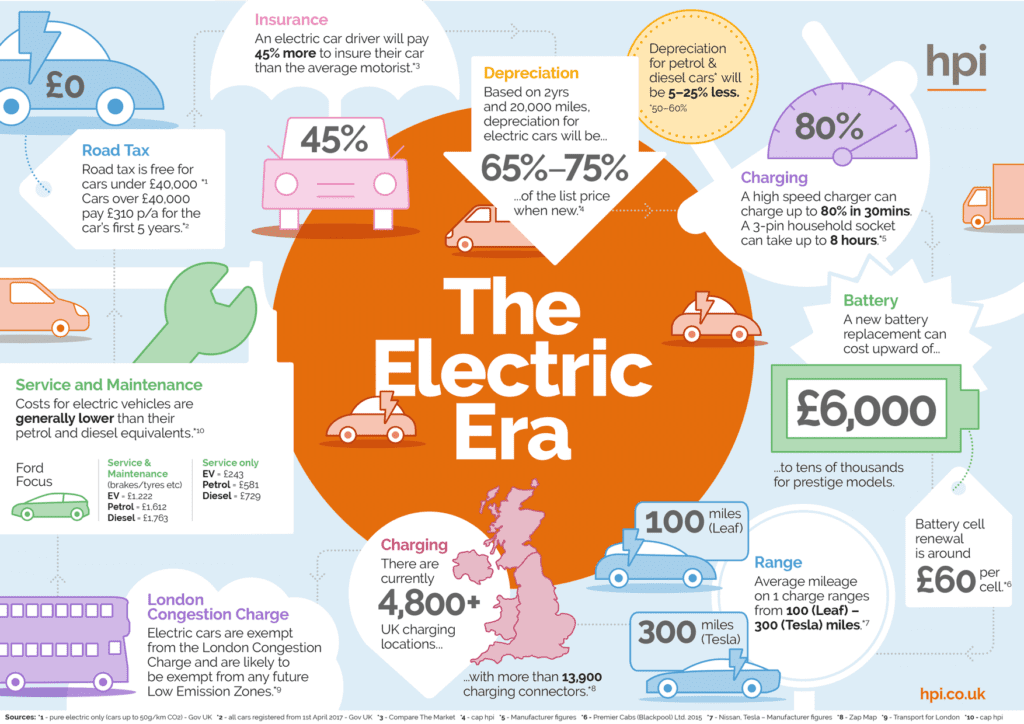
Electric cars are quite a hot topic right now, particularly since the government announced its ban on the sale of new diesel and petrol only cars by 2040. For those who want to do their bit to improve air quality, switching to an electric car is a perfectly feasible option once you know your your electric car facts. In our infographic below we’ve pulled together some interesting facts about electric cars that you should consider when deciding if switching to electric is right for you. We look at electric car range, electric car charging to depreciation and electric car road tax. Thinking of buying or selling a car? Visit hpi.co.uk for the best information available on any car
Electric Car Service & Maintenance Costs
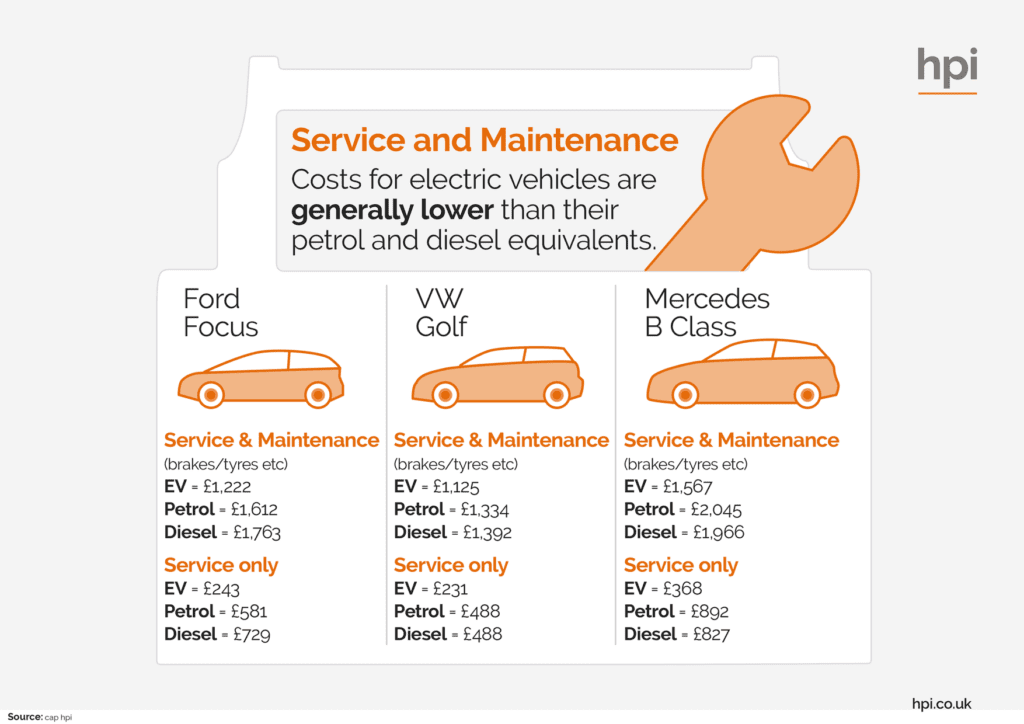
Are you wondering about the cost of an electric car service compared to diesel and petrol? Electric car service and maintenance costs are generally lower than for petrol and diesel. Below is a comparison for three models where there is a diesel and petrol version in the range. All are automatic models to keep the comparison as similar as possible as there are no manual electric vehicles. Note: Tyre sizes are the same with the exception of the Mercedes where the rim size is the same but with a different aspect ratio. Find out electric car service and maintenance costs with our free tool below. Service and maintenance costs are included as part of our free, easy to use valuation service. Our free valuation tool will tell you: Current market values for private sale, trade-in, forecourt and price at new Past, current and future trade-in values Total cost of motoring, incl. running costs, and costs for service and maintenance Our valuation tool isn’t just for electric cars, you can check service and maintenance costs for petrol and diesel cars too. Get a free valuation now! [iframe src=”https://hpivaluations.com/i/hpiblog/start” width=”360px” height=”370px” class=’aligncenter’ style=”margin:10px auto; height:370px”]
Electric Car Pros & Cons
Electric cars are in the news a lot at the moment, largely because air quality has become such a hot topic. Conventionally powered vehicles (petrol and diesel) are one of the key sources of pollution in busy city centres, and one of the main advantages of electric cars is that you’ll be doing your bit to reduce air pollution. Electric vehicles have been around since the dawn of motoring at the turn of the 20th century but it’s only within the past decade that they have become a mass-market proposition. The first mainstream model designed from the outset as an electric car was the Nissan Leaf (launched in 2010), and since then the market has expanded with models from BMW, Tesla and Renault among others. There are many things to consider when deliberating on the benefits of electric cars and whether or not an electric car is right for you. We’ve listed some pros and cons that are worth mulling over before you decide to make the switch. Advantages of electric cars: Improve local air quality More efficient, so fuel costs are lower Very easy to drive, nippy around town Cheaper to service (BEVs) Grants reduce purchase costs (BEV and PHEV) Can refuel quickly (HEVs and PHEVs) Disadvantages of electric cars: More costly to buy Lose value more quickly Patchy public charging network (BEVs and PHEVs) Often cost more to insure The range is often limited (BEVs) Sometimes no more frugal than a normal car (HEVs and PHEVs) Can take a long time to charge (BEVs) While it’s only recently that affordable and usable electric cars have been available in significant numbers, for years before that there was also an array of hybrid cars to choose from. While a hybrid car isn’t electric, it is electrified, and that’s an important distinction that many people are unaware of. Not only is there a difference, but to complicate things further, there are five types of electrified vehicle: Battery Electric Vehicle (BEV) These are electric cars that are powered solely by electricity stored in battery packs. Buy one and you’ll have to charge it up at home, at work or from a charging point such as on the motorway. There’s no on-board back-up power supply (i.e. an engine), so get caught with a flat battery and you’ll have to be recovered. BEVs include the Nissan Leaf, Renault Zoe and all Teslas, while BMW offers an electric-only i3. Hybrid Electric Vehicle (HEV) A hybrid is an electrified car that features either a petrol or diesel engine, although it’s rarely the latter, as diesel engines cost more to make than petrols. This engine drives the wheels and is backed up by an electric motor powered by a battery pack. The batteries are charged up by the engine, or when the car is slowed (either by using engine braking or the car’s foot brake). Examples include the Toyota Prius and lots of other Toyota and Lexus models, along with the Bentley Bentayga and Kia Niro. Plug-in Hybrid Electric Vehicle (PHEV) HEVs have an electric-only range of typically just four miles because of the size of the battery pack. By fitting a larger set of batteries the electric-only range can be increased to more like 30 miles, with efficiency being improved by having the ability to recharge the car via a mains supply. Such cars are called plug-in hybrids (PHEVs) and they bridge the gap between a pure electric car (BEV) and a conventional hybrid in that it contains the best elements of both. As a result these cars are costly but they have still become much more common over the past couple of years, with the introduction of models by BMW, Mercedes, Volvo, Volkswagen and many more. Range extender (REX) The range extender is much like a plug-in hybrid to use, as it features a petrol engine and a battery pack. However, the wheels are always driven by electric motors powered by the battery pack which is charged up by the engine. So the engine acts solely as a generator, but there’s always the option of charging up the battery pack from a mains supply. The now-defunct Vauxhall Ampera and Chevrolet Volt were the first range extenders to be sold in the UK; the BMW i3 and i8 are still on sale though. Hydrogen fuel cell Just to complicate things there’s a fifth type of electrified car, and that’s the hydrogen fuel cell. Available in tiny numbers, the only model available in the UK is the Toyota Mirai, although Hyundai sold a hydrogen ix35 until recently. Although car makers have been developing hydrogen fuel cell models for decades, the technology is still in its infancy. So is the infrastructure as there are just four hydrogen refuelling stations in the whole of the UK, three of which are in London. The difficulty with making a viable hydrogen fuel cell car is reducing the cost, improving the reliability and shrinking the technology to a suitable size. While mass-market hydrogen fuel cell cars are still some way off, the technology is being used in buses, which in diesel form are one of the key sources of pollution in urban environments. By switching to hydrogen this pollution is eliminated altogether, as the only emission from a hydrogen fuel cell is water. Although there are five different electrification technologies, they all get lumped together as AFVs, or Alternatively Fuelled Vehicles. So an AFV is simply a vehicle that’s electrified, which can mean that it’s pure electric, a hybrid or a range extender, with the odd hydrogen fuel cell thrown in for good measure. Such vehicles are starting to prove big business as they accounted for 4.6% of the cars sold in the UK up to the end of September, which equates to over 94,000 units. But is an AFV right for you? Richard Dredge Thinking of buying or selling a car? Visit hpi.co.uk for the best information available on any car
The Future Of Diesel – Video Explainer
Poor air quality has become a huge topic of discussion lately and diesel is said to be one of the main sources of air pollution. Diesel engine vehicles have been targeted by governments around the globe as part of their action plan to clean things up. The UK government recently announced a ban on the sale of new diesel and petrol only vehicles by 2040. Aside from a diesel car ban there are other measures in effect or pending that could affect diesel drivers in the UK. We answer some important questions: Will this affect diesel car values? Should you still buy a diesel? What is the diesel scrappage scheme? Diesel vs petrol? Our short video paints the bigger picture and provides some interesting facts to help you understand what the future of diesel cars looks like. Use our free valuation tool to find out the current and future value of your diesel [iframe src=”https://hpivaluations.com/i/hpiblog/start” width=”360px” height=”370px” class=’aligncenter’ style=”margin:10px auto; height:370px”]
The Future of Diesel – Diesel Facts & Stats
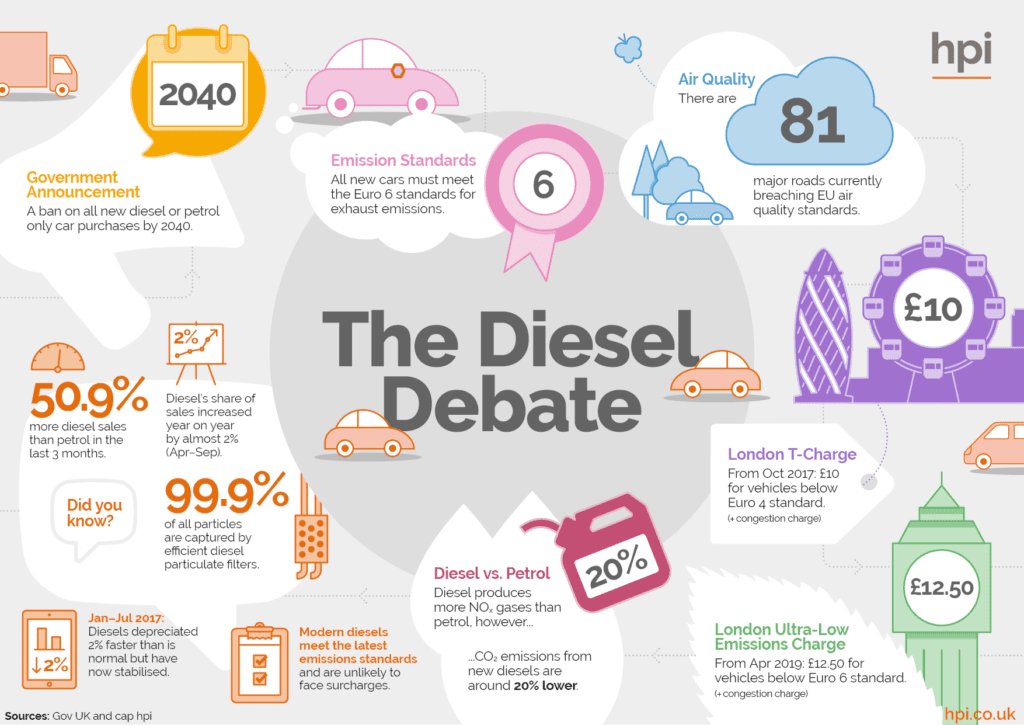
The future of diesel cars is a hot topic right now and there is a lot of worrying information flying around that doesn’t paint the brightest picture for diesels. With that said, we decided to pull together some interesting diesel facts and statistics that may well surprise you. Have diesel values been affected? Diesel vs petrol – how does diesel fare against petrol when it comes to air pollution? Are people still buying diesel cars? What kind of surcharges are being imposed on cars that don’t meet Euro Emissions Standards. Use our free valuation tool to find out the current and future value of your diesel [iframe src=”https://hpivaluations.com/i/hpiblog/start” width=”360px” height=”370px” class=’aligncenter’ style=”margin:10px auto; height:370px”]
The Future of Diesel Cars – Q&A
The future of diesel cars? Read the mainstream press and you could be forgiven for thinking that the future of diesel cars looks bleak. The problem is that some mainstream journalists don’t understand cars – the technology or the market – and as a result there’s a lot of misinformation around. Here we separate the facts from the fiction. 1.Why is everyone talking about diesel? Poor air quality has become a big issue in cities around the globe, and one of the sources of the air pollution that has been targeted is the fleet of diesel-engined vehicles that fill urban streets. That fleet is made up of buses, lorries and private cars, and governments around the world have decided to take action to clean things up. When the debate started we kept hearing about 40,000 people dying prematurely in the UK because of poor air quality, a figure since debunked (www.bbc.co.uk/news/science-environment-39129270). But the fact remained; the pace at which transport is cleaned up needs to be accelerated as quickly as possible. The government was already encouraging new-car buyers into hybrids and electric cars (known as AFVs, or alternatively fuelled vehicles) with an up to £4,500 grant. The grant is the carrot; next come the sticks, with the supposed announcement of a petrol and diesel car ban by 2040. To improve local air quality local authorities have also been told to come up with their own schemes, and with diesel engines said to be one of the key contributors in the generation of nitrogen oxide and particulates, those will bear the brunt of any measures. These schemes have to be drawn up by March 2018 and are likely to include restrictions on car use or charges to drive in urban environments, and greater use of public transport – even though buses and trains are generally diesel-powered, as are all the lorries that deliver our goods. 2.What’s the future of diesel cars looking like? Around the world, governments started to announce bans on diesel-engined cars in some cities – and sometimes bans on petrol-engined cars too. In the case of the UK government it announced a petrol and diesel car ban by 2040 – or did it? Actually, no. What it said is that by 2040 only hybrids and electric cars will be allowed – and a hybrid can be powered by a petrol or diesel engine. What the government has banned is the sale of new non-electrified cars from 2040. That means any car that doesn’t have electric assistance won’t be allowed, but in 23 years’ time all cars are likely to be electrified anyway; Volvo will be there within two years. But the company has said that it won’t offer pure-electric cars because the technology isn’t viable yet for most consumers. In the short term other sanctions are likely to be imposed. Diesel will probably be taxed at a higher rate than petrol, a surcharge could be applied to the Vehicle Excise Duty (road tax) and it’s likely that owners of diesel cars will be charged more to enter the Low Emissions Zones that will spring up all over the place in urban environments. Parking charges may also be increased; Westminster already imposes a £2.45 per hour surcharge to park a pre-2015 diesel car. That’s 50% more than an equivalent petrol-engined car or AFV. 3.Will this affect the value of my diesel car? The demand for diesels is still very healthy and values are refusing to drop. In fact, over the first half of 2017 diesel-engined cars depreciated at a slightly faster rate (2%) than is normal but have now stabilised, which just goes to show how demand continues to match supply. September’s used sales volumes clearly showed that motorists favoured diesel over petrol fuelled vehicles (by 50.9%). The overall diesel share of the sales market is actually higher this year compared to last year. 4.What is the diesel scrappage scheme? When the government announced there’d be a diesel car ban by 2040 (which isn’t actually a ban, remember), one of the measures that was touted to help improve air quality was a scrappage scheme for older, dirtier diesels. The government dismissed the idea saying that such a scheme would offer poor value for money. It may be that a targeted scheme is introduced at some point but it’s unlikely now that most of the mainstream car makers have taken it upon themselves to introduce their own scrappage schemes. In most cases the cars that are traded in on this scheme will be scrapped, but not all; some will be returned to the road. Predictably, those scrappage schemes vary from one manufacturer to another in other ways. Not all of them are restricted to diesels, there might be restrictions on which new car you can buy (in terms of CO2 emissions, cost, model range) and other factors include how long you’ve owned the car you’re trading in as well as how old it is. Also, while the trade-in value of your car is theoretically fixed, how much you’re given for it will depend on which new car you buy. If it’s a model that isn’t in demand or is high-value you’ll get more for it than if you want the latest model that everybody else also wants. 5.Should I buy a diesel car? Even before all this talk of a diesel car ban became commonplace there were lots of things to consider when choosing between diesel vs petrol (along with electric or hybrid). Fuel economy was the driving factor for many owners but you have to remember that if you choose a diesel car you’ll pay more for it (new or used). If you’re buying according to your eco conscience, diesel can still make sense if you buy a Euro 6 model. All new cars sold since September 2015 must be Euro 6-compliant which means they’re just about as clean as their petrol counterparts – it’s the earlier diesels that are much dirtier. Diesels are also undeniably more economical
Electric Cars – Stars and their not so reasonably priced electric cars

As consumer interest in the electric vehicle (EV) sector continues to grow, automotive data experts cap hpi has compiled a list of high profile celebrities who are leading the EV charge. Celebs who currently own/have owned EVs or hybrids: Hollywood actor George Clooney – one of the first owners of the Tango T600 Hollwood superstar Tom Hanks – Toyota RAV4 EV Actor and renowned environmentalist Leonardo DiCaprio is a big fan of EVs (he owns a Fisker Karma luxury range-extended EV) and even formed a team – Venturi Grand Prix – for the inaugural season of the Formula E Championship Mr Bean actor and comedian Rowan Atkinson and presenter James May – BMW i3 Morning TV presenter Lorraine Kelly and DJ Mark Goodier – Nissan Leaf Black Eyed Pea musician and producer Will.I.Am, Superstar DJ deadmau5, actress Cameron Diaz and vocalist with British alternative metal band Bring Me the Horizon, Oliver Sykes – Tesla Model S Fashion guru Gok Wan, TV presenters Carol Vorderman and Quentin Wilson – Opel Ampera Former Manchester United manager Alex Ferguson – Chevrolet Bolt. Football pundit and former Man United and England defender Gary Neville – BMW i8 Action superstar and former Governor of California, Arnold Schwarzenegger owned a Tesla Roadster Recent analysis from cap hpi also revealed the best buy EV cars based on best motoring value for money. Citroen C-Zero Hatchback Peugeot Ion Hatchback Volkswagen Up Hatchback Hyundai Ionic Hatchback Ford Focus Hatchback The analysis* looked at used EVs for those motorists thinking of making a switch to an alternative fuel type from petrol or diesel. Once all the servicing, fuel and other motoring costs are taken into account, the Citroen C Zero Hatchback boasts the lowest total cost of ownership at £18,319 (£508.86 per month) making it the best value used electric vehicle currently on the market. Many of these vehicles aren’t cheap, often requiring a celebrity’s salary to make them affordable. Popular with many celebs, the Tesla Model S Hatchback and Model X Hatchback have a TCO of £43,027 and £53,279 (£1195.19 and £1492.47 per month) respectively. Chris Plumb, Black Book editor at cap hpi, said: “Over 60,000 new AFVs have joined Britain’s roads so far this year. The overall used market for electric vehicles is also on the up with residual values increasing slowly but surely. EVs and plug-in hybrids can provide a good balance between range and efficiency plus the economic benefits can be enormous, offering big savings on fuel and tax costs as well as much lower maintenance costs. “Lots of celebrities seem to like the benefits that EVs provide particularly the stars who are active environmental campaigners. It’s good to see them putting their money where their mouths are and leading by example. Consumer interest in electric vehicles continues to soar now could be a good time to consider switching to a used EV although for higher end models the price rage is going to be out of reach for the majority of ordinary motorists.” A detailed infographic covering essential facts and figures on EV ownership is available to download here https://www.hpi.co.uk/content/newsroom/electric-cars-the-electric-era/electric-cars-facts-stats/ ENDS *Data based on 2015/15 plate and 20,000 miles. For more information contact Nathan Lane on 07447 921654/ [email protected] or Terry Gilligan on 07770 703541 / [email protected]
HPI Euro Emission Standards Checker

What is Euro 6? What are the Euro emissions standards? Euro emission standards describe the acceptable limits for exhaust emissions of new vehicles sold in the EU. Below are the Euro emissions standards Euro 1 – 6 that have been introduced so far, Euro 6 emission standards being the most recent classification. The first date is the point at which any new car submitted for type approval had to fall within the relevant Euro standard. The second date (in brackets) is the date from which any new car sold had to meet the standard. There’s usually a year or so between the car being introduced and it having to meet the rules when it’s sold. The hpi euro emissions standard checker below will tell you which Euro Standards classification your car has. Use our free hpi emissions checker below to check the Euro emissions standard of your car. [iframe src=”https://hpicheck.com/api/euro-status” width=”300px” height=”180px” class=’aligncenter’ style=”margin:10px auto 0 auto; height:180px”] Disclaimer: This tool is intended for personal use as a guideline only. We rely on data sourced directly from our partners. However, we provide no warranty as to the accuracy of the information and accept no legal liability or responsibility for its accuracy. Older or more unusual vehicles may not be covered by this tool. If you have concerns about your vehicle’s emissions you should consult with the retailer or manufacturer for more information.
hpi launches an emissions standard checker

Commuters face confusion on how they could be affected by the introduction of clean air zones in Britain’s cities. To help motorists understand if they have to pay a levy, automotive data expert hpi has launched a free online tool to check the Euro emissions rating of a vehicle. A survey from the RAC found 38% of motorists had not heard of the Euro Emission Standard classification system, while 64% of those who had were unsure what category their vehicle fitted in. The RAC warned there was no easy way of finding out a vehicle’s Euro emissions standard. A £10 toxicity T-Charge has been introduced in central London for vehicles which do notmeet the Euro 4 standard, generally those registered before 2006. The Government has also given local councils the ability to bring in clean air zones with charges for the worst polluting vehicles. Fernando Garcia, consumer director at hpi, said: “The changing legislation around vehicle emissions can give motorists a real headache and leave them out of pocket. Our new online check is completely free and allows motorists to check the emissions standard of their vehicle and potentially avoid a fine.” Use our free hpi emissions checker below to check the Euro emissions standard of your car. [iframe src=”https://hpicheck.com/api/euro-status” width=”300px” height=”180px” class=’aligncenter’ style=”margin:10px auto 0 auto; height:180px”] Disclaimer: This tool is intended for personal use as a guideline only. We rely on data sourced directly from our partners. However, we provide no warranty as to the accuracy of the information and accept no legal liability or responsibility for its accuracy. Older or more unusual vehicles may not be covered by this tool. If you have concerns about your vehicle’s emissions you should consult with the retailer or manufacturer for more information.
A car driven by a heavy smoker could easily lose up to £2,000 at trade-in

Smoking in vehicles carrying children is a law which was enforced on 01 October 2015. The news gives reminder about smoking and our health, but any smokers needing another reason to quit should also be aware of the damage their habit can do to vehicle values.