

8 Future Classics for Under £10k
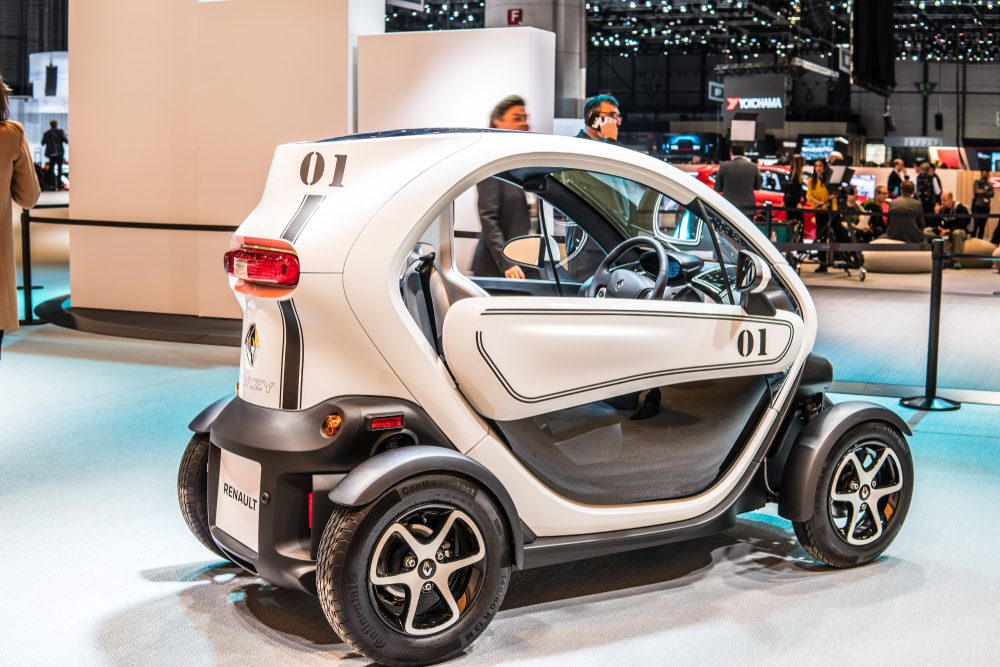
Take a look at our list of vehicles which we think could prove to be future classics. Motoring expert Clive Wilson identifies eight cars that are relatively cheap to acquire are holding their values and could potentially become future collectors’ items, representing a potentially good buy for people willing to invest. Mr Wilson said: “There is no set formula for picking a future classic car that will prove to be an appreciating asset. However, certain factors prove to be reliable markers. In this study, we considered cars that are available in low volumes and a great drivers car. We also looked at cars that stand out with an unusual or quirky design. Our picks are all available for under £10k and could prove a savvy investment in the years to come.” Here are eight possible contenders all for under £10k: Renault Twizzy – As the popularity of electric vehicles is booming the quirky design of the Twizzy makes it stand out from the crowd. Produced in very low volumes, they are fun to drive. With the potential to become the first electric classic, they can be purchased for as little as £3500. Renault Avantime – There are very few of these left now. They can be purchased for under £4k, however, expect to pay up to £10k for an excellent low mileage example, if you can find one. Alfa Romeo Brera – A very modern looking car when produced and a design classic. The sweet sounding 3.2 V6 would be my pick, and there are already signs this model appreciates in value. They can be picked up for under £10k, but many are demanding much higher values now. Peugeot RCZ – While there are still plenty of these around they have now ceased production so choose a low mileage example with good provenance while you can. It’s a good longer-term prospect, and the GT 200BHP version is the rarer model, a low mileage example can be found for under £9k VW Golf GTI/VR6 mk5 – The iconic hot hatch answered the demands from the customer following a heavy and disappointing mk4. A great drive and well-built so will withstand the tests of time. However, low mileage examples are becoming harder to find now so choose carefully as a collector will not want a modified car. Prices start at around £4k. Porsche Boxster – They are the volume model for Porsche hence early examples can now be found for well under £10k. The condition is key with this car as there are plenty out there that have been well used. Suzuki Jimny – The little SUV has a dedicated fan base. They are a very slow depreciator, and values can be quite seasonal depending on the time of year. Summer is the best time to take advantage of this seasonality as even if you get buyer’s remorse, you can be sure values will be higher when winter hits. Prices start at around £2k Toyota MR2 – A reliable and fun convertible which have a good following. If you look carefully, there are still some pristine low mileage examples out there, and it is these cars which are the potential investment. While examples can be found for as little as £2k, I would recommend spending at least double that to provide a better investment chance. Our car valuation is free to use and provides 4 market values, with a condition adjustable trade-in price, and a past and future values graph. [iframe src=”https://hpivaluations.com/i/hpiblog/start” width=”360px” height=”370px” class=’aligncenter’ style=”margin:10px auto; height:370px”]
Celebrating 80 years of cap-hpi!

This year is a big one for HPI, as the company is celebrating 80 years of being the go-to brand for used car buyers to check that potential purchase doesn’t have a hidden past. We’ve seen a lot of changes in that time, with data moving online, the amount of information contained in an HPI check going up exponentially, and the cars we monitor being developed beyond all recognition. When HPI set up shop way back in 1938, the Austin Seven was still in production and it would be another decade before the Morris Minor or Land Rover would make their debuts. The disc brake had yet to appear, airbags and seatbelts were still a long way off, while radios and heaters were the preserve of a few very luxury cars at the top of the market. In the same year that HPI launched, the first Volkswagen Beetle prototypes were built. The Beetle wouldn’t hit the road until 1945 but production would last right the way through to 2003, with the distinctive two-door saloon going on to become the biggest-selling car in history with 21.5 million of them finding homes. A year after the production Beetle arrived the British car industry celebrated its 50th birthday, with long-forgotten marques such as Jowett, Armstrong-Siddeley and Wolseley all introducing new models for the post-war era. For the first time ever, the AA’s membership ran to more than 500,000 and while times were hard, consumerism would hit with a vengeance in the 1950s. Over the coming years we would see the introduction of now iconic brands such as Ferrari (1947), Porsche (1948), Lotus (1951) and Lamborghini (1963). The Fiat 500 burst onto the scene in 1957, a year before the Austin Healey Frogeye Sprite – the original mainstream budget sportscar. The first British motorway opened in the same year; the M58 Preston bypass is now part of the M6. In 1959 the Mini arrived and changed small-car motoring forever with its efficient design, brilliant handling and front-wheel drive. Six years later, in 1965, the first Japanese cars went on sale in the UK, with the charge being led by Daihatsu, Toyota, Honda and Datsun (later Nissan). In those days these oriental upstarts were eyed with suspicion and dismissed by British rivals – a move they would later come to regret. Over the next half a century we’d have an oil crisis, and British Leyland would become Austin Rover then MG Rover before disappearing altogether. People carriers would surface, only to be superseded by SUVs and crossovers, while the British car market would become dominated by German brands that just a decade before were very exclusive. Once-independent marques would amalgamate or collaborate, and people would stop buying their new cars, preferring to pay for them in instalments instead, via a PCP. The last decade has seen high-tech features become ever more important to car buyers who replace their cars more frequently than ever thanks to the pace of change. Equipment that was once available only in luxury models has filtered down to superminis and city cars – features such as Auto Emergency Braking, satellite navigation, heated seats and even heated steering wheels. However, what’s set to come will be even more impressive, with car makers shoehorning ever more technology into their cars. This technology will make our vehicles safer, cleaner and more luxurious than ever before, but instead of buying cars we’re set to rent them instead. That’s the view of 13 motoring experts who we spoke to – people at the sharp end of the car industry. They gave us their predictions of how quickly the motoring landscape is set to change over the course of this century – and beyond. The concensus of our expert panel is that within the next decade in-car internet will become the norm, allowing you to communicate with your appliances at home while cars will also talk to each other, leading to fewer crashes. All of this tech will coincide with cars being able to take on more of the driving, with self-parking cars becoming standard issue. Look forward another decade (10-20 years’ time) and autonomous cars will allow us to work, sleep or eat as we’re whisked from one destination to another. The unknown is how quickly this will happen, as laws and insurance regulations might slow the pace of change – but what isn’t in doubt is that this is coming. As cars become ever more complex and laden with technology they’ll also get a lot more expensive. With people less bothered about owning their car they’ll be happy to rent a vehicle as and when they need one, whether that’s for a short trip from one side of town to the other, or to go away for a week’s holiday. As has already started, hybrid vehicles will become much more common while electric cars will also become more usable as costs drop and real-world range increases. You might think that the days of diesel cars are numbered, but our experts reckon the decline of these – along with petrol-engined cars – will be more drawn out than you might think. Hydrogen will become a viable fuel source, selling alongside electric vehicles in the longer term, driven largely by Governments forced to focus on cleaning up our air, which is why renewable energy will be at the forefront of our transport systems. So while the changes we’ve seen over the past eight decades have been all-encompassing, what’s coming in the next 80 years is far more impressive. Our transport systems are set to undergo a revolution with every aspect set to change beyond all recognition. Throughout the year we’ll be giving you an insight into how vehicle crime, the driving test, car ownership and technology are all set to evolve at an unbelievable pace. Make sure you join us as it’s going to be quite a ride. Richard Dredge March 2018
Where do our experts see Motoring over the next 80 years? – Video

To celebrate the 80 years of industry experience and expertise; we pinned down 13 internal and external industry experts* to get their view on what the future may hold for motorists in the coming years. Check out our short animation to find out what our experts predict may be in store. *Contributing car manufacturers: Mitsubishi, Volkswagen Group, Audi, Hyundai and Fiat Chrysler Group. Editors and consultants interviewed from cap-hpi included Joel Albyn, Matt Freeman, Chris Plumb, Barry Shorto and Andrew Mee.
What Are the Biggest Driver Distractions?
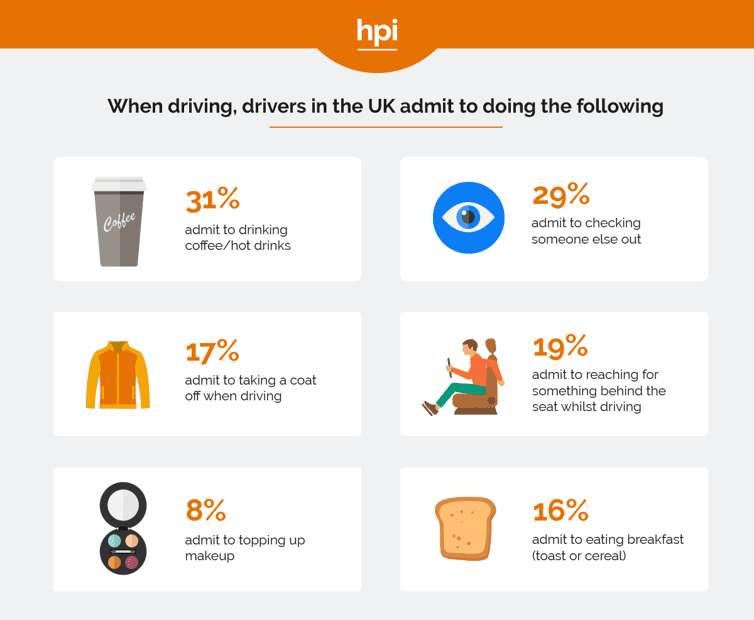
Driving requires a high level of concentration to stay safe, be aware of hazards and react accordingly. Yet a lot of drivers become distracted when behind the wheel, whether due to being in a rush on the morning commute and attempting to drink coffee or losing focus and letting their mind wander. Recently the law changed to clamp down on distracted driving by increasing the penalty to six points and a £200 fine for those using a phone. But there are many other driver distractions that can prove just as dangerous. At HPI we looked into what the top driver distractions and bad habits are.
The changing fortunes of the Toyota Prius

We’ve had a flurry of emails from people over recent weeks, asking about Toyota Prius values. There’s a lot of uncertainty in the marketplace right now, about whether values of this all-conquering hybrid family car will go up because of the current focus on air quality. Or will they go down because of the turmoil in the private hire market, led by question marks over whether Uber will continue to operate in the capital? With an estimated 15,000 Toyota Priuses currently plying their trade in London (plus many more privately owned examples), if demand was to collapse because of changes in the private hire market, a sudden glut of used cars would possibly reduce prices significantly. But is such a scenario really likely to happen? We’ve crunched the numbers to see how Prius values have changed over the past decade, and the variation is much greater than you might expect. Look at the graph and you can see that at the end of 2007 you could buy a three-year old Prius with 60,000 miles on the clock for £9,500. Less than three years later (by August 2010) that had dropped to just £6,000 – but fast forward another three years and Prius values were on an upward trajectory that seemed to show no signs of slowing. As with any commodity, Prius values are dictated by the balance of supply and demand. So a decade ago there weren’t enough Priuses to go round and values were buoyant as a result. A few years later, Toyota had sold a lot more examples of its evergreen hybrid hatch and demand had softened slightly as diesel sales boomed instead. The result was a marked reduction in values. Things came to a peak in the spring of 2015 when the value of a three-year old Prius with 60,000 miles on the clock had jumped to just over £13,000. By this point the Prius would have been a Mk3 edition; a much more accomplished vehicle than the Mk2 valued at £6,000 in 2007. Interestingly, the Volkswagen emissions scandal hit in September 2015 but over the next year Prius values declined significantly, from that £13,000 high to just under £11,000. Once again it was because of the balance of supply and demand; while the latter rose, so did the former. It would be logical to assume that Prius demand has been driven at least in part by the private hire market, which has become big business in the UK in recent years, most notably with the likes of Uber. While the private hire market has no doubt played its part in boosting demand for the Prius, whether or not Uber remains a big player in the UK will make little difference to Prius values. Mark Bursa is the editor of Professional Driver magazine the leading magazine for the private hire industry. He says: “It’s been claimed that 40,000 people drive for Uber in London, but this figure probably represents the total number of drivers who have signed up since Uber arrived five years ago; the number of people now actively driving for the company is much smaller. “The thing is, Uber is one of many companies offering the same thing; a taxi ride at the swipe of an app. Uber’s rivals are smaller and more local, but if it should lose its licence to trade in any particular town or city, its drivers will just switch to another company offering the same service. Many of Uber’s drivers already work for rivals, because while some private hire companies insist on exclusivity, Uber doesn’t. As a result it’s very common for an Uber driver to also be signed up to Green Tomato Cars, or iRide for example”. So while some people have assumed that these changes in the private hire market might lead to the used car market suddenly being inundated with unwanted Toyota Priuses, it’s highly unlikely because it will continue to be one of the favoured vehicles for the private hire industry. Besides, Uber drivers will continue to need their cars because if they stop working for Uber, they’ll just switch to another company and carry on. Mark Bursa offers another reason why the used car market won’t suddenly be saturated with these Toyotas: “Private hire drivers tend not to buy their cars as it’s too much money to have to find up front. To help with cashflow it makes a lot more sense to lease, and that can be done on a short-term or long-term basis. If a driver decides they don’t want their car any more at the end of the lease, they can hand it back but it probably won’t be sold on – instead it’ll be leased back out to somebody else”. Of course not all private hire drivers opt for a Toyota Prius (or the seven-seat Prius+); many choose instead to go for a diesel-powered MPV or estate car such as a Ford Galaxy, Volkswagen Sharan or Skoda Octavia. But the Prius has long been the transport of choice because much of the private hire work is for the corporate market, which means that image is all. Being seen to be environmentally friendly with your transport choices can be a very big deal, which is why some private hire companies use hybrids (and sometimes now electric cars such as the Nissan Leaf). So what of the future? Gazing into our crystal ball we see mixed messages, because in the wake of diesel car sales reducing sharply the number of hybrids sold will go up significantly. But after dominating the hybrid segment for years the Prius will find itself up against an increasing amount of mainstream competition as manufacturers rush to electrify their cars. So while one of these elements would lead to an increase in values, the other will have the opposite effect. As a result, Prius demand is bound to remain steady and as long as Toyota doesn’t saturate the market, values should remain buoyant. Richard Dredge March 2018 Use
New Car Prices Rise 38% in Last Decade
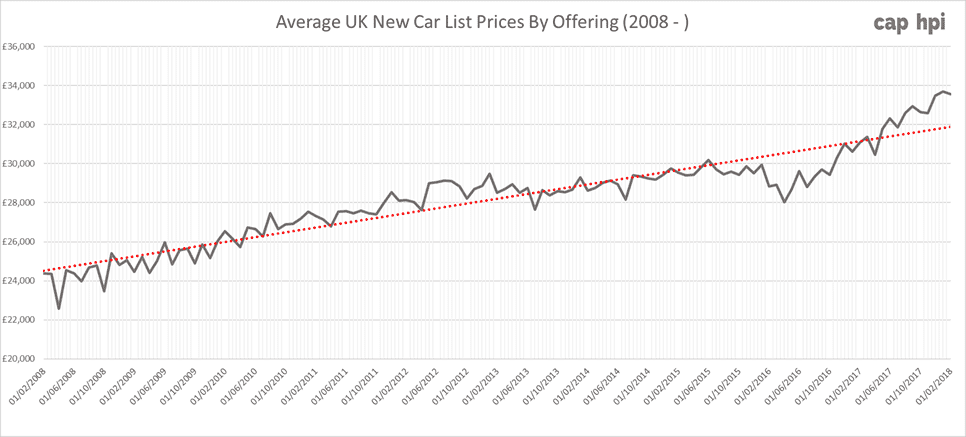
Analysis by automotive data experts cap hpi has revealed the average price of a new car has risen 38% over the last decade. The average offered price of cars has increased from £24,383 in February 2008 to £33,559 in February 2018. The experts argue that while cars sold today are fitted with much more technology, from satellite navigation to self-parking, the increased cost is not always reflected in the price rise. New technology is often rolled out as standard by manufacturers seeking to improve the competitiveness of their products. Matthew Freeman, managing consultant at cap hpi, said: “The real driver of this is the changing structure of the marketplace. Over the past decade, we’ve seen more expensive models being rolled out. We see more SUVs on our roads, and they are usually more expensive than the equivalent saloon.” The company’s data also reveals more premium brand cars across almost every segment and premium brands experimenting with new segments. The expansion of diesel ranges has also driven up the average price of a new vehicle as diesels are around £1000 more expensive than the equivalent power petrol version. Freeman said: “Many brands have moved to offer a more luxurious specification mix and eliminated their entry-level specifications. This is partly a response to PCP making cars more affordable, and consumers moving up to more expensive models. It’s also worth noting that those base models were not especially desirable in the used market, and had poor resale values. “PCP has also shifted focus from the entry price to the monthly repayment and having a model to advertise as ‘From £9,995’ is no longer a priority – cars are more likely to be advertised on their monthly payment.” PRESS RELEASE
Tougher MOT for Diesels Launches in May
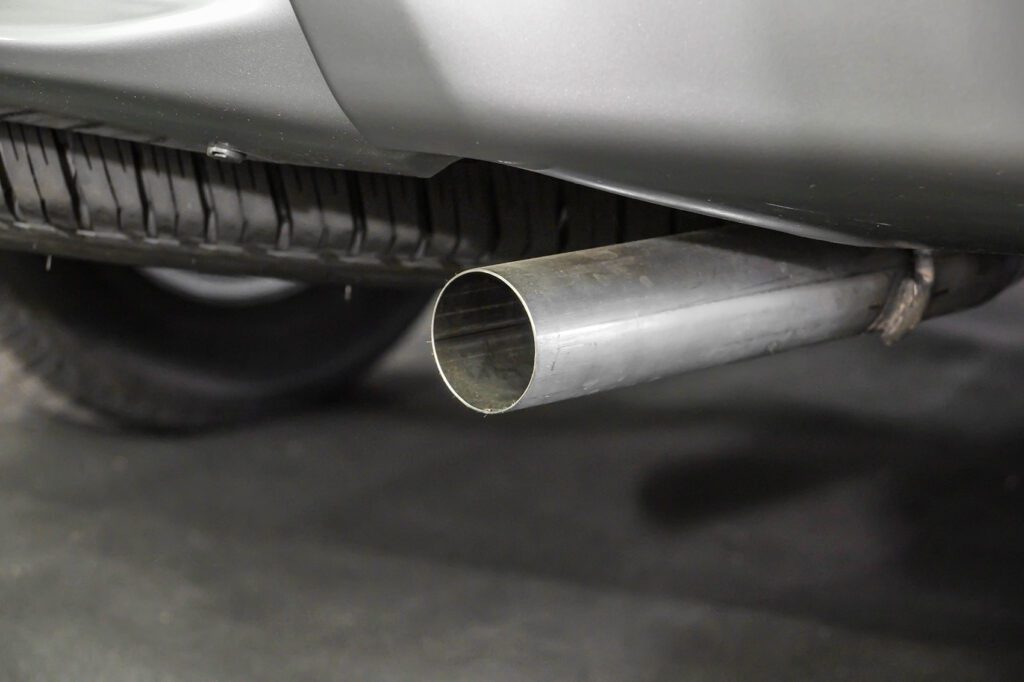
As poor air quality becomes an ever bigger problem in towns and cities across the UK, the government has launched a crack down on dirty diesel cars in a bid to improve things. From 20 May, a more stringent MOT test will make it much harder for poorly maintained or illegally modified diesel cars to pass the MOT. The revised test will include a package of measures aimed at all cars, with diesels a particular point of focus. It’s diesel-engined cars sold from September 2009 (59-plate or newer) that are being targeted especially, as these must be fitted with a diesel particulate filter (DPF) to pass strict emissions regulations. These can clog up and are expensive to replace, so some owners have had them removed – a practice that’s been illegal for several years already. From 20 May, an MOT tester will have to check that the DPF hasn’t been tampered with. If it shows signs of having been cut open and stripped out, the car will fail its MOT. Similarly, if the car was built with a DPF but it’s since been removed, an MOT fail is guaranteed. A diesel particulate filter is fitted to massively reduce the amount of soot that a car’s exhaust emits. If it’s working properly a DPF should ensure there’s no soot or smoke visible with the engine running. That’s why the new MOT test will include a check for “visible smoke of any colour”. If there’s any sign of smoke being emitted the car will fail its MOT. If this news has now got you worried that your car might fail its next MOT, the new rules are being introduced to ensure that your car has been properly maintained and that it hasn’t been messed about with. So as long as your car has been serviced according to the manufacturer’s schedule and you haven’t illegally tampered with the DPF, there really is nothing to worry about. Richard Dredge February 2018
How to Spot and Avoid a Car Scam
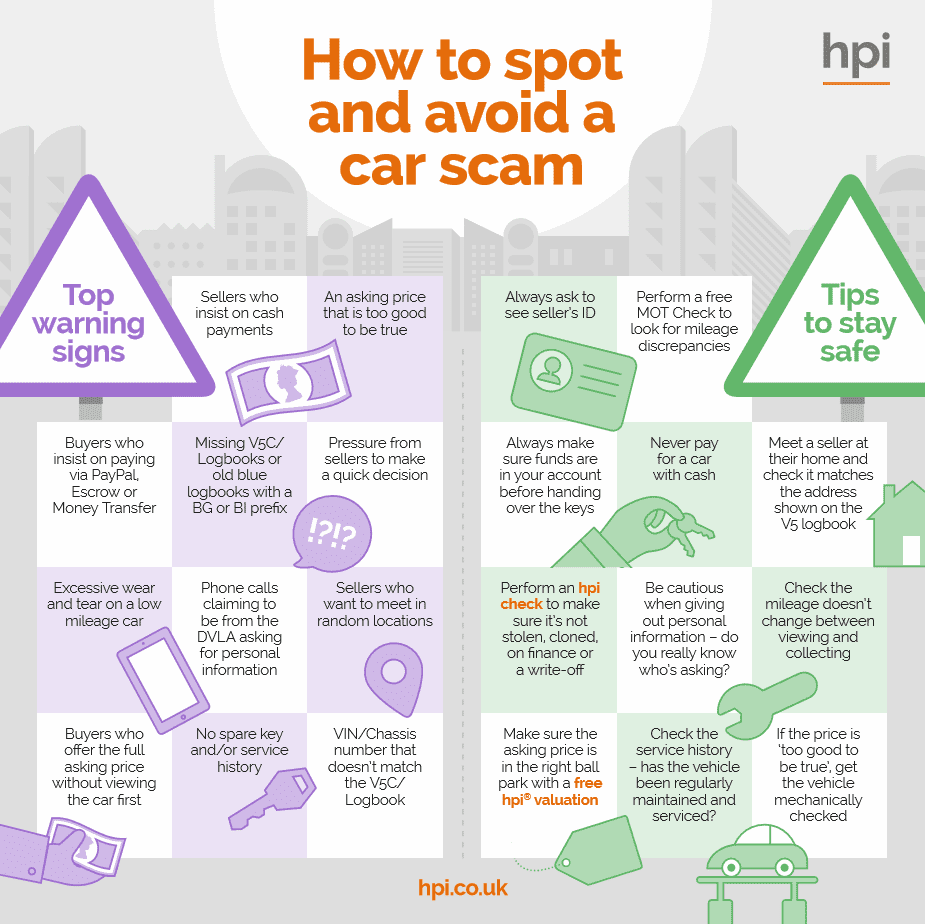
Awareness is key to enjoying a stress-free used car buying experience. Use our guide below to spot any tell tale car scam signs and learn how to stay safe when buying a used car. If you’re armed with facts, buying a used car can be the joyful and satisfying experience that it should be. Common sense, a little scepticism and reliable vehicle information are all you need to navigate what can sometimes feel like a secondhand car buying minefield. If you’re worried about the history of a car, check it NOW using our tool below. [hpicheck]
2018 MOT test changes

A tougher set of MOT test rules will be introduced on 20 May, making it harder for your car to get through the annual roadworthiness check. We’ll detail what those changes are below, but if you need to get up to speed on what the MOT is and how it works, our previous blog on the MOT system will reveal all – our article on how to decipher your car’s MOT history is also worth a read.
How to Stay Safe when Buying a Used Car

HPI is here to make buying a used car less stressful, and we like to be positive, but we’re not going to lie: you really need to have your wits about you at purchase time, because there are lots of people out there intent on stitching you up. Every day we perform thousands of vehicle history checks and what we discover is often pretty frightening. For example, last year we identified 27,062 stolen cars, which works out at an average of 74 every day. A third of the vehicle checks were still subject to outstanding finance, while almost 1800 cars were found to be insurance write-offs. That’s not over the year by the way – that was the daily average. Yep – nearly 1800 cars every day had been deemed a total loss by an insurance company. Then there were the mileage discrepancies; on average we encountered almost 1300 cars with a mileage discrepancy, every single day. It’s estimated that the value of the number of miles wiped off all of those used cars is around £800m each and every year. At the risk of scaring you further (we’ll get to the good stuff soon, promise), if you buy a stolen car or one that’s got finance owing on it, you could lose your money as well as the car. A stolen car is owned by the insurance company that paid out when it was pinched, while if it’s still subject to finance, it’s owned by the finance company that lent the previous owner the cash to buy it. If it’s a write-off or has been clocked you may be able to keep the car – but it could be worth much less than you paid because of that hidden history. In the past we’ve brought you blogs that explain write-off categories and what happens when your car is written off. We’ve also spilled the beans on the dangers of buying a car on finance and we’ve also explained car clocking to you, so for much more on those topics click on the relevant link. Now the good stuff OK, so enough of the scare stories – what can you do to protect yourself when buying a used car? Plenty, is the simple answer. The first one has to be to get an HPI Check. We’re not just saying that because we’re HPI; we’re saying it because we’re the market leaders in vehicle history checks, which is why we’re the first port of call for many traders before they buy their stock. That’s quite a recommendation. Also think about how the vendor is going about trying to sell their car. A genuine seller won’t pressure you into making a quick decision, they’ll be flexible with how you pay and they’ll have all of the car’s documents to hand, including its V5C (registration certificate or logbook) and lots of service history. They will also have priced the car realistically; if it seems unusually cheap you should smell a rat. The key thing is to trust your instincts – the world is full of second-hand cars, so don’t feel pressured into acting rashly because you’ll only regret it. When viewing a car make sure it’s at the vendor’s address – which should be the one on the registration document. That will tell you plenty about what they’re like in terms of looking after things, because if the house and garden look like a bomb site the chances are that the car hasn’t been cared for any better. You don’t have to be a qualified mechanic to be able to tell if a car is on its last legs; worrying sounds or smells, part-time electrics and brakes that pull to one side all point to a car that needs attention. The same goes for warning lights on the dash, a really baulky gear change or steering that feels odd. You don’t need to be a master mechanic to spot any of these things. The two key things that should give you some peace of mind are a comprehensive test drive and putting the car through an MOT. If the vendor is set against either of these just walk away. You can get an MOT on a car at any time and before buying any car you should take it on a long test drive (at least 20 miles) on as many types of road as you can. Only then are any faults likely to show. Meanwhile, an MOT will flag up if there are any problems with the car’s brakes, emissions, bodywork, seatbelts, electrics and far more; you can learn more about how the MOT works by reading our blog on the subject. There are plenty of ways that unscrupulous sellers will try to con you out of your cash; our blog on the most common car scams explains all. Before you start shopping you should also read and digest the information in our blog on common V5C scams. Our article on the key checks you should make is essential reading too. None of this should put you off buying a used car at all. Just use the information available to you, remember that forewarned is forearmed, and when the stakes are as high as this you need to make sure that you’ve done as much research as possible. Buying a used car can be a scary experience, but if you do your homework first the whole process will be a lot more enjoyable. Richard Dredge January 2018