

Buying Your First Used EV: A Guide

Used EVs don’t have to be confusing minefields of misinformation. HPI’s guide explains what first-timers need to know and how to approach the buying process. Buying your first used electric car doesn’t have to be a daunting task. While much of the process mirrors buying a second-hand petrol or diesel vehicle, there are a few additional considerations specific to EVs. Can You Charge It? This is the critical factor. If you can charge the car at home or nearby, you’re a good candidate for an EV. Homeowners with off-street parking can install a domestic charge point and charge overnight, which is the most cost-effective method. Public charge points near your home or workplace are also viable options. Without accessible charging, an EV may not be practical for you. Factor in the Cost of a Charger Installing a home charge point typically costs between £800-£1,000. Some energy suppliers offer EV-specific tariffs that might include a home charger, saving you upfront costs. Check with main dealers if you’re buying an approved used car, as they might bundle a wallbox with the purchase. What Type of Electric Car Do You Need? Consider your driving habits: how far you drive, how often, and how much space you need. Modern EVs can offer ranges over 300 miles, while older models might provide around 100 miles. Use a mileage tracker app to determine your needs. If you don’t require extensive range, older models can be a cost-effective choice. How Much Should You Pay? Used EV prices have decreased significantly, now often cheaper than their petrol and diesel counterparts. For example, values of models like the Jaguar i-Pace, Mercedes EQC, and Tesla Model X have dropped substantially, making high-end EVs more accessible. Similarly, cars like the Nissan Leaf are now much more affordable. Exact comparisons can be tricky, but HPI data shows three-year-old EVs are on average 8.7% cheaper than petrol and diesel models. Retail prices of EVs are generally 8.5% cheaper at three years and 14% at four years. Watch this video so you make the right EV choice: https://www.youtube.com/watch?v=eGS34ENu4S4 Check the Vehicle’s History An HPI Check Report is crucial when buying a used EV. It will alert you to any issues reported by finance and insurance companies, the DVLA, the Police, and other industry bodies. The HPI Check also includes a Total Cost of Ownership (TCO) calculator, which helps you understand the vehicle’s running costs over the next three years. Get started here: https://hpicheck.com/ Is the Battery Covered? Manufacturers usually offer a separate warranty for the battery and related components, commonly eight years or around 100,000 miles, ensuring the battery retains at least 70% capacity. Verify the car’s service history to ensure the warranty is still valid. Take a Test Drive Test driving a used EV is crucial, especially if it’s your first time. The driving experience differs from petrol or diesel cars, with instant torque and quieter operation. Aim for the longest test drive possible to fully acclimate. Check the Cables Ensure the car comes with its charging cables, as replacements can be expensive. Most UK EVs use Type 2 chargers, but variations exist. Verify the cable type and condition. Consider Specialist Insurance Look into specialist EV insurance policies, which cover aspects unique to electric cars, such as wallbox damage and charging cable theft, and may include EV-specific recovery services. Should you go EV? An EV can offer a reliable, enjoyable, and cost-effective ownership experience. If you find a vehicle you’re interested in start your EV journey with a HPI Check, to ensure that you’re armed with all the vehicle information you need to make the best choice for you. https://hpicheck.com/
HPI’s Partnership with NaVCIS – A Commitment to Combat Vehicle Theft Across Europe

Since 2021, HPI has supported the National Vehicle Crime Intelligence Service (NaVCIS) in their mission to combat vehicle theft across Europe. Our collaboration has resulted in the successful recovery or prevention of theft for 320 stolen finance vehicles, highlighting the crucial role of our data and technology in fighting organised crime. The Scope of Our Success NaVCIS, funded by the Finance and Leasing Association (FLA), specialises in recovering stolen finance vehicles. With a dedicated team operating across Europe, they’ve identified and returned vehicles worth £9.6 million. Notably, Romania and Bulgaria have been significant destinations, accounting for 60% of the total value of recovered vehicles. These criminal activities often involve thieves obtaining vehicle finance either under their own names and failing to pay or through fraudulent identities. Once in possession of the keys, these vehicles are typically fitted with false plates and transported out of the UK via ferries, shipping containers, and the Channel Tunnel. The Role of HPI Check Data HPI’s contribution to this partnership is invaluable. Our vehicle data aids NaVCIS and European law enforcement agencies in identifying stolen vehicles at re-registration centers across Europe. By providing real-time, updated information, we ensure that stolen vehicles are quickly flagged and seized, preventing their further transit and sale. Sharon Naughton, Head of NaVCIS, remarked on the complexity of these cross-border crimes and the essential role of timely data in thwarting criminal efforts. She emphasised that our partnership with NaVCIS is critical to the success of their operations. Expanding Our Reach Looking ahead, HPI is committed to supporting the expansion of NaVCIS’s efforts. Our data director, Jon Clay, “Advanced technology ensures that our data is updated in real-time, and we’re pleased to support the vital work undertaken by NaVCIS. Expanding our partnership will help make it even harder for criminals targeting financed vehicles.” Ensuring Vehicle Security for All HPI Check provides motorists with comprehensive vehicle histories, ensuring transparency and security. By identifying discrepancies such as outstanding finance, theft reports, accident data, or mileage tampering, HPI Check helps protect consumers and maintain trust in the automotive market. HPI and NaVCIS: A Strategic Alliance Our partnership with NaVCIS underscores HPI’s commitment to providing data and technology in the fight to support law enforcement’s efforts against vehicle theft across Europe. NaVCIS trust HPI Check data, so you can too.
Demand for diesels still buoyant
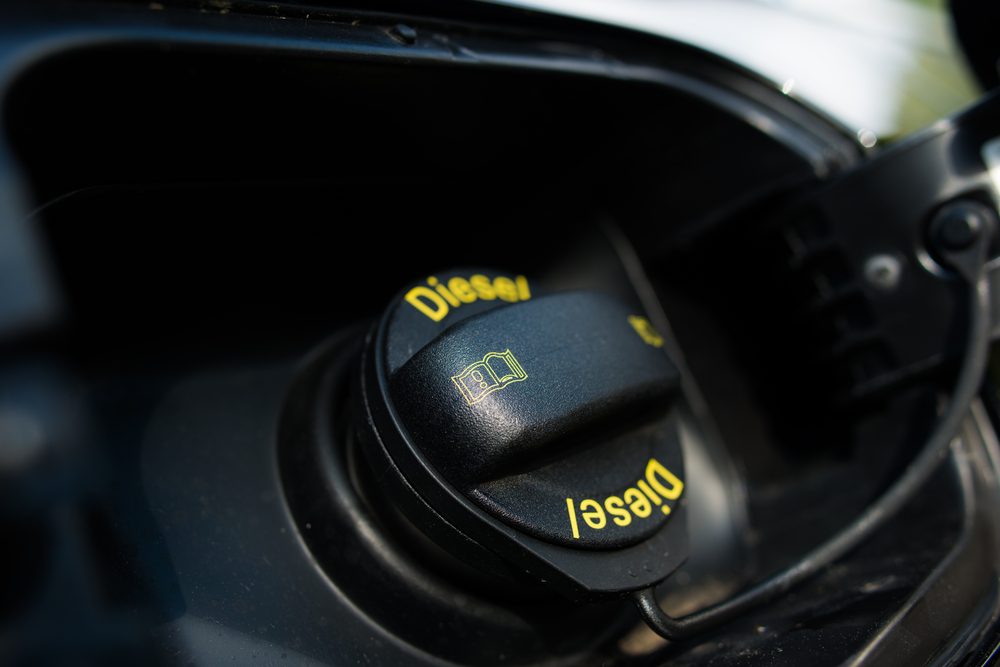
The bottom has dropped out of the market for new diesel-engine cars, so it stands to reason that the same must also be true for used cars. If nobody wants a new diesel car, then presumably nobody wants a used one either, leading to a considerable drop in value. That’s certainly what you’ll hear from the self-appointed car expert who sits in the corner of the snug in the Red Lion, but the reality is that his claims are false. In fact, the exact opposite is true. While sales (and therefore supply) of new diesel cars have significantly decreased, there’s been no let-up in demand on the used market. And as any economics enthusiast will tell you, if you reduce supply but demand stays the same (or increases), a rise in prices is sure to follow. Diesel cars arrived in the UK in significant numbers in the 1980s, with intensity building in the 1990s. By the turn of the century, diesels were no longer the poor relation, with drivers encouraged to shun petrol in the quest for greater fuel efficiency and fewer CO2 emissions. Accounting for just 19% of new-car sales in 2007, diesels went on to command 56% of the market in 2011. Much of the increase was due to diesel becoming the default choice for company car drivers who wanted to benefit from low benefit-in-kind tax bills, while fleet managers loved the lower fuel costs. But unfortunately, diesel hid a dirty secret because while the fuel economy is inherently better, the exhaust emissions used to be nothing like as clean. However, just as the tide was turning against diesel towards the end of 2015, the current Euro 6 emissions regulations were coming into force, which forced diesel-engine cars to be virtually as clean as their petrol-engine counterparts. Despite this, we were all told that diesels are dirty, so buyers started to shun them, not recognising the vast advances made in cleaning things up. Over the past few years, the anti-diesel car agenda has gathered momentum, and now consumers have no idea which way to go when buying a new car. An increasing number are opting for an electric car or a plug-in hybrid, and for many people, that’s a great choice. But for a lot of high-mileage drivers, diesel makes the most sense. Yet just 261,772 diesel-engine cars were registered in the UK in 2020, compared with 581,772 in 2019. Admittedly the pandemic skewed things somewhat last year in terms of the number of new cars sold overall, but to put things into perspective, diesels accounted for 31.5% of the market in 2018, 25.2% in 2019, and a mere 16% in 2020. A couple of years ago, we published a blog on whether or not you should buy a new diesel car, which was swiftly followed by one on whether or not you should buy a used diesel. Our advice remains evergreen, but it’s important to note the supply of decent second-hand diesel-engine cars has reduced further. Some of this is down to buyers shunning diesel because the received wisdom is that the fuel is bad, but a big part of it is down to car manufacturers dropping diesel options from their ranges. According to an Autocar article, new-car buyers had 493 different diesel cars to choose from in November 2015, and five years on that had dropped to just 267 — with many of those on borrowed time. The reality is that few new cars are sold as such. More than 80% of private buyers sign up to a PCP, so they’re just committing to a monthly charge for three or four years. Most company cars are leased, so those fuelling the new-car market don’t have to worry about long-term running costs or reliability. They’ll run the car only while it’s in warranty and they can afford to have the latest technology. But those buying used aren’t always in such a fortunate position. Low running costs are often more important, which means no expensive battery packs to replace, along with the best possible fuel economy. Hence the lack of appetite for electrified cars, but a more significant demand for diesels (and petrols, too). What’s important to bear in mind is that there are regional differences around demand. Those in rural areas have a greater appetite for ICE (internal combustion engine) cars than those in urban settings, especially if there’s a Clean Air Zone in place. At HPI, we expect demand for diesel cars to remain healthy compared with supply, unless there is a significant change in government legislation. The graph here shows how the value of used diesel cars has increased over the last year, in line with petrol cars. Thanks to strong demand in the used car market overall, diesel values increased by an average of 11.1% over the year. In contrast, petrol-engine cars performed even more impressively, with an average increase in value of 11.6%. Meanwhile, electrified cars (electric cars and hybrids) have not held their value so well; they dropped in value considerably for a while but have recently started to recover. Taking July 2020 as our starting point, values of petrol- and diesel-engine cars rose by almost 5% over the next three months, whereas electric and plug-in hybrid models initially stayed nearly static before falling away quite sharply. Hybrids performed the worst of all and continued to do so until the last few weeks when they started to recover, overtaking electric cars in the process. Compared with a year ago, the only electrified cars that have seen any gain in average values are plug-in hybrids, which are up by 4%, whereas hybrids are typically down by 2.4%. Coincidentally, electric cars have dropped by 5.2%. Part of the reason for the lack of enthusiasm for used electric vehicles (EV) and hybrids is the high purchase cost; electrified cars tend to be significantly more expensive to buy than an equivalent petrol- or diesel-powered model. Many consumers still don’t feel confident that they know enough
COVID-19 IMPACT ON CAR VALUES
If you are thinking about buying or selling a used car over the next few weeks, you could be concerned about the market and its impact on car values. Used car values are influenced by a wide range of factors with supply and demand as the key drivers. Our experts examine data from across the wholesale and retail markets to ensure that vehicles reflect the market in real-time. You can value your car at hpivaluations.com The good news is that 2020 got off to a strong start and February was the strongest month for used values since 2012. So, whilst values have dropped since then, year-to-date in total they have held up reasonably well. New Car Sales The new market influences the used market and often when the new market shrinks, it can restrict the supply of vehicles into the used market which drives prices up. Official registration statistics reported that February 2020 ended 2.9% down on the same month last year, with 79,594 cars registered compared to 81,969, which means the market was down 5.8%. Private sales have been the most affected, down 11.7% year-to-date, driven by weak consumer confidence which preceded the COVID-19 pandemic. Demand for diesel cars fell again, and this is already down 25% year-to-date, with petrol cars down 5%. Mild hybrid vehicles are included in both of these figures. Alternatively-fuelled cars continue to grow in popularity, however, with battery electric vehicles (BEV) up 218%, plug-in hybrid vehicles (PHEV) up 88% and hybrid electric vehicles (HEV) up 33.5% for the year so far. Used Car Retail Activity Again, it feels like a long time ago now, but the start of March was buoyant for many car retailers. Carrying on from the previous two months, footfall on the dealer forecourts was healthy as was online activity. Trade values increased by 1.7% on average since the start of January, so the biggest issue for dealers was maintaining their margins as the price motorists pay remained steady. During the first week of March, the shadow of COVID-19 was largely still to appear over retail forecourts, despite the onset of the pandemic in China and Italy. During the second week (commencing 9th of March), the industry began to feel the impact of the pandemic. There was a sea change in the market mid-month, with retail demand affected over the weekend of 14th/15th as the country accelerated in its realisation of the seriousness of the situation. From Monday 16th, when the government introduced daily updates and with the measures to counter the spread of the virus, retail demand took a dramatic downturn. Enquiries and test drive levels dropped to around half where they had been the previous week, and many appointments were cancelled. The situation in the country changed daily from the 16th, with consumer footfall at car retail sites dropping off steadily as the public were urged to limit social contact. The weekend of the 21st/22nd saw further declines, with reports of sales rates down around 60-70% from where they should have been in more normal times. Although these volumes of sales were nowhere near where retailers would have liked, they were still reasonably high considering consumers were being urged to shop for essentials only – obviously, a car purchase would have been seen as this for some. The evening of 23rd March will be remembered by most who witnessed it for years to come. The British Prime Minister, Boris Johnson, announced what amounted to a lockdown, with all non-essential businesses forced to close. This included closure of car showrooms, although many had already taken this action before the decision was taken out of their hands to protect their employees and customers. While online activity remained for many, this lockdown still had an immediate effect on the industry. Despite trade values dropping, results from retail advertised pricing analysis on the 25th March showed there had been no discernible movement. Most retailers realised that reducing prices would not stimulate the market, and consumers are not staying away due to prices but because of other extenuating circumstances. Used Car Values Used values in March were tracking at a -0.3% movement from the previous month by Friday, 13th – reasonably healthy, especially considering values had been going up for the last two months. However, in line with retail and trade demand, there was a dramatic effect on used car prices from Monday, 16th. The overall movement during March, leading to April’s monthly values, was an average drop of 2.2% (-£275) at the three-year, 60,000-mile point, the majority of which happened in the final 10-days of valuing. For newer used cars, the drop was 1.8% (-£425) at the one-year, 20,000-mile point. Our final day of valuing, before we cut off for the monthly product, was the day after the Prime Minister announced non-essential retail sites closing and informing the public to stay at home, so reflecting pricing movements as of Monday 23rd of March. In effect, what this average movement has done is reverse the existing increases from earlier in the year of 1.7%, minus a further 0.5%. As would be expected, all kinds of cars have been affected by this decrease in values. The niche sectors of convertibles and coupe cabriolets, where evidence was lower, have been slightly less affected in percentage terms. What Next? In the short-term, it is clear that both used and new car sold volumes will reduce dramatically – we have already witnessed this in the immediate aftermath of the country lockdown. During this time, we will continue to analyse the data but do predict that prices are unlikely to move until car showrooms are allowed to reopen and the market returns to some semblance of normalcy. The situation does seem to change daily, and we have not yet reached the peak of infections in the UK, so it would be almost irresponsible to predict too much. It is not easy to predict what will happen to the market. Government support will help, but still, these are tough
CAR CLOCKING – THE ROAD TO RUIN?

LATEST ‘CLOCKING’ DATA REVEALS AN ALARMING INCREASE IN VEHICLE MILEAGE FRAUD What’s the issue? According to our latest data, one in 11 vehicles undergoing an HPI Check is identified as having a mileage discrepancy. That’s a worrying increase of 45% in the past five years and the highest levels of fraud that the motoring industry has ever seen. As a result, UK motorists should beware of buying ‘clocked’ cars with questionable mileage records that could see them being ripped off or even worse, risking their safety. The problem is getting worse year on year and, for anyone in the market buying a used car, it can have serious implications for both finances and safety behind the wheel. As one of the UK’s leading authorities on vehicle checking services, HPI estimates the practice of mileage tampering often known as ‘clocking’ is costing motorists over £800 million every year. It is illegal to sell a clocked car without declaring its genuine mileage, but what may come as a surprise to most people is that the act of altering the car’s odometer is not an offence. The illegal practice of clocking takes place when drivers look to deliberately defraud second-hand car buyers when the vehicle is sold on. The hard evidence The alarming figures from our own HPI Check data show an increase of 22.2% for 2019 over 2018’s figure when one in 14 vehicles was recorded as having a mileage discrepancy. The actual number of vehicles identified as having a confirmed mileage discrepancy for the whole of 2019 was 836,214, a ‘hit’ rate of 8.99% compared to 7.35% (607,981) for 2018. NMR (National Mileage Register) is the official system used to check vehicle mileage by HPI, which has now surpassed over 369 million readings making it one of the largest, most accurate sources for verifying and investigating mileage records. Our data confirms that with the increase to one in 11 cars registering some form of mileage discrepancy, the actual volume of vehicles on UK roads with a mileage discrepancy has increased by nearly half (45%) over the past five years. The statistics make for grim reading. They have increased steadily over the years, recorded as one in 14 in 2018, one in 16 in 2017, 2016 and 2015 and one in 20 vehicles in 2014. In addition to mileage problems, as motorists we should also be aware that there is a one in three chance of uncovering another hidden problem when buying a used car such as having outstanding finance, having previously been an insurance write off or even being recorded as stolen. What can be done to avoid buying a car with a mileage discrepancy? Checking a car for mileage discrepancies comes as standard in the HPI Check . By building up a history of a vehicle’s mileage, checking the last three times it was recorded on the NMR, and cross referencing with MOT records, it can highlight any discrepancies and arm car buyers with the information and confidence they need when dealing with used cars. It can also reveal whether a vehicle is currently recorded as stolen with the police, has outstanding finance against it, or has been written off. Carrying out a mileage check from HPI will flag any mileage discrepancies through two reliable sources – the National Mileage Register and the car’s own MOT history. So, if a car has been clocked or had its odometer tampered with, then the mileage reading will appear to have decreased which is a false reading. A vehicle’s mileage is directly linked to its value – this is why it is so important that the mileage reading is accurate and has not been altered in any way. Turning back the clock on a car can inflate the price considerably. Buying a car that’s had its mileage tampered with can and often does lead to unforeseen mechanical problems cropping up sooner than they should, which could have safety implications, or lead to hefty repair bills. All the safety features and modules in a modern car, such as airbags, ABS and ignition, feed information into the vehicle’s central computer system. Each time an issue arises such as a fault warning – a ‘snapshot’ of the vehicle’s mileage will be logged. Unless a vehicle’s mileage is wound back by a particularly smart clocker who knows to alter the mileage readings on all modules as well as the odometer, these will be out of sync. This will lead to issues with safety warnings – making it potentially very dangerous for drivers, any passengers and other road users. Next steps for those looking to buy a used car It can be difficult to spot a clocked vehicle just by looking at it but there are a few tell-tale signs such as: worn pedals, extra shiny steering wheel, excessive wear to seats, mats and carpets. Trust your judgement when weighing a car’s apparent mileage and its general condition – does it add up? Remember a clocked vehicle could be hiding serious levels of wear and tear, especially if it has been previously used as a high mileage private hire vehicle, meaning additional costs for unexpected repairs or even a potentially serious safety threat. With an increasing number of car buyers now opting for PCP deals, the motivation to avoid financial penalties at the end of a car’s lease period is ever present. If you’ve got your eye on a used car and want to avoid becoming a victim of mileage fraud, then your first line of defence should be an HPI Check. Click here to find out more.
GETTING TO GRIPS WITH LONDON’S ULTRA LOW EMISSION ZONE

Drivers, businesses and service operators of larger vehicles weighing 3.5 tonnes and above are being advised to check how the incoming Low Emission Zone (LEZ) changes will impact them when changes to new legislation come into force, all thanks to a free online vehicle emissions checker. From October 2020, changes to the existing LEZ will mean that 4×4 pick-ups and caravans will join HGVs, coaches and buses as part of a range of larger vehicles that will need to meet new stringent emissions criteria to enter and operate within the M25. It is highly probable that many drivers will be confused by the incoming changes which is why HPI is helping drivers of 4 x 4s, pick-up trucks, motorised horseboxes and motor caravans prepare themselves from being unwittingly penalised for driving a vehicle within or exceeding designated weight restriction levels.* The first Ultra Low Emission Zone (ULEZ) came into force in London in April 2019 as part of an environmental strategy the Mayor of London is driving to clean up London’s toxic air. The rationale behind the ULEZ is simple. London’s air pollution is increasing people’s risk of heart and lung disease and asthma. Road transport is the biggest source of the emissions damaging health in London. That’s why the government through Transport for London is taking action to help clean up our dangerously polluted air and vastly improve public health. Around half of emissions of nitrogen oxides (NOx) come from transport. They contribute to illegal levels of nitrogen dioxide (NO2) and particulate matter (PM) – pollutants which make chronic illnesses worse, shorten life expectancy and damage lung development. The communities suffering most from poor air quality are often the most vulnerable, including children. It is estimated that there are at least 360 primary schools in areas with illegal pollution levels. ULEZ represents one way to help tackle the most harmful emissions generated by road transport in central London and throughout the city. One of the major benefits of the ULEZ is that its introduction will help cut exhaust NOx and PM emissions, improving air quality and making central London a safer and more pleasant place to live, work and visit. The young, older people and those who have respiratory problems, as well as people who reside in high pollution areas will all feel the benefit of ULEZ. Most of the traffic entering the ULEZ will be from outside the zone, so the benefits of cleaner, greener vehicles in the form of reduced emissions will be experienced across London, even to areas not in the zone. HPI’s free online emissions checker allows users to establish the Euro emissions rating of their cars and LCVs up to and including Euro 6 standard and helps them understand how they are impacted by driving in London’s ULEZ. The tool helps motorists identify which vehicles will need to meet Euro 6 standards or be liable to pay a daily charge to drive within the Greater London area. In the past five months alone we have already helped over 53,000 drivers and can support many more around the UK who will be affected by the rollout of clean air zones across British cities. Of the vehicles checked by the tool in the past five months, the following vehicle types have been checked most often: Euro 6 – 44.6% Euro 5 – 41.1% Euro 4 – 11.3% Euro 3, Euro 2 and Euro 1 amount to 3% of the total This equates to around 350 checks per day or over 2,400 per week. Current LEZ emissions standards set a limit for how much particulate matter a vehicle may emit. The tougher standards will also set a limit for nitrogen oxides (NOx) for some vehicles. Following the launch of the UK’s first ULEZ in the capital, attempts to replicate the scheme are already rolling out in major cities throughout the country. Numerous Clean Air Zones (CAZs) are currently being implemented in cities where transport pollution is a major problem. The first five cities outside of London required to introduce a Clean Air Zone are Birmingham, Derby, Leeds, Nottingham and Southampton. The Government regulations aim to bring nitrogen dioxide levels within the legal limit in the shortest possible time by 2021 at the latest, and has also named 23 local authorities where it expects pollution levels to reach illegal levels by 2021. They must all carry out a feasibility study to determine whether a Clean Air Zone is required. Drivers who enter the capital in vehicles which do not comply with the new emissions will be subject to a £12.50 fee on top of the £11.50 congestion charge. Charges apply once in every 24-hour period (midnight to midnight) when entering or driving in the zone. This would apply seven days a week, 365 days a year. In addition to the existing LEZ emissions standards operating across most of Greater London, phased implementation of these tougher emissions standards will affect different vehicle types and different geographical areas within London. Now is the time to check and take the necessary steps to avoid incurring penalties later in the year as there is margin for drivers of certain vehicles to be caught out especially with different vehicle weights. Over the next 12-18 months drivers will face lots of changes as a result of the implementation of the Government’s commitment to a clean air strategy. Our online check is completely free and allows motorists to check the emissions standard of their vehicle up to and including Euro 6 and potentially avoid a fine. You can check your vehicle’s Euro Emission Standard here: https://www.hpi.co.uk/content/newsroom/the-future-of-diesel/euro-emission-standards-explained/ Euro emissions standards explained: Euro 1 -July 1992 (Jan 1993). From here on all cars had to have a catalytic converter and run on unleaded petrol to cut carbon monoxide emissions Euro 2- Jan 1996 (Jan 1997). The limits were cut for carbon monoxide, unburned hydrocarbons and oxides of nitrogen, with different emission limits for petrol and diesel Euro 3 – Jan 2000 (Jan 2001). Carbon monoxide and
Hidden Danger: Insurance Write-off Categories Explained
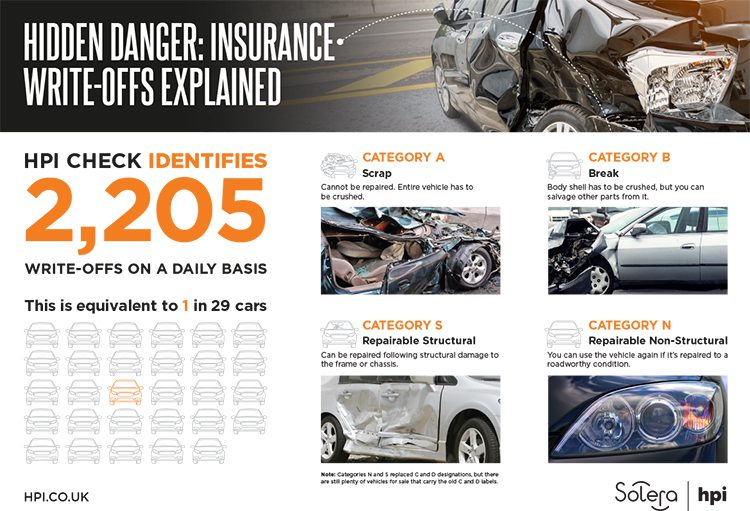
When choosing a pre-owned vehicle to purchase, how do you really know what you’re getting yourself into — both literally and figuratively? What you don’t know may hurt you when it comes to a vehicle’s hidden past, most notably when it comes to write-offs. Cars get written off by insurers because they’re either so damaged they’re not safe to drive or will cost more to fix than what they’re worth. Either way, a write-off is something you typically want to avoid. On a daily basis, HPI Car Check data identifies 2,205 cars as insurance write-offs just as those vehicles are presumably being considered for purchase. Unwittingly buying an insurance write-off can have serious safety and financial implications, beyond just paying an artificially inflated cost. That’s why it’s important to understand how the system works. When an insurance claim is filed on a car after an accident, fire damage or theft, it’s assessed by the insurance company to determine whether it’s worth repairing. Car insurance assessors follow a Salvage Code produced and supported by the Association of British Insurers and designed to protect the public, detect and deter insurance fraud and other criminal activities and to make vehicle histories more transparent. In October 2017, new insurance write-offs came into effect to reflect the rising complexities involved in repairing today’s vehicles. Categories N and S replaced C and D designations, but there are still plenty of vehicles for sale that carry the old C and D labels. Today, buyers considering vehicles that have been damaged will get a better sense of the impact, plus the V5C is now marked with an S to denote a salvaged vehicle. The code requires all salvaged vehicles to be categorized as listed below. Write-off Categories A – Scrap Unsuitable or beyond repair and has been identified to be crushed in its entirety, including otherwise salvageable parts. These are cars that have been damaged so badly, they’re not safe to be put back on the road. They must be completely destroyed. B – Break Unsuitable or beyond repair. The body shell has to be crushed, but other parts can be recycled/resold, such as wheels and seats — even the engine. S – Repairable Structural Can be repaired following structural damage to the frame or chassis. The vehicle can be used again if it’s repaired to a roadworthy condition. Cars in this category must be re-registered with the DVLA before becoming road-worthy again. N – Repairable Non-Structural Can be repaired following nonstructural damage, so the problem could possibly be cosmetic, or electrical (e.g., lights, heated seats or an entertainment system) and too costly to repair. However, there may still be some safety critical items that require replacement such as steering and suspension parts. Insurance companies can sell write-offs in the S and N categories back to the original owner or to a third party through a vehicle salvage company. It’s the responsibility of the keeper to notify DVLA when a Category S vehicle is passed to an insurer following a total loss payment, but no notifications are made when a Category N car is written off. C Can be repaired, but it would cost more than the vehicle’s worth. The vehicle can be used again if it’s repaired to a roadworthy condition. D Can be repaired and would cost less than the vehicle’s worth, but other costs (such as transporting your vehicle) take it over the vehicle’s value. The vehicle can be used again if it’s repaired to a roadworthy condition. Cars in these categories can sometimes be a bargain. An older car can occasionally be safely repaired at a lower standard than dictated by an insurance company using less expensive labor or used parts. But, buyer beware. Know that insurance can be harder to come by for cars that have been written-off, and some insurers refuse to cover them at all. For categories C, D, S and N, expect higher premiums and a lower resale value when you’re ready to sell. At any rate, it’s worth getting a thorough mechanical inspection from a qualified mechanic before buying a car because, unfortunately for the typical buyer, it can be difficult to distinguish a write-off on sight. And, as for the seller, well he may or may not be knowingly exploiting his customers. Although some sellers may attempt to disguise Category N or S vehicles as undamaged by hiding their past. One way to know what you’re getting yourself into is to use an HPI Car Check to scrutinise the history of any motorised vehicle registered in the UK, including cars, vans and motorbikes. The comprehensive check alerts you to any troubling information held against the vehicle by finance and insurance companies, the DVLA, police and other industry bodies. While an HPI Car Check can alert you to an insurance write-off if the insurance company has declared it a total loss or the DVLA has marked it as scrapped, there are a lot of other red flags you’ll want to be aware of. As a matter of fact, one in three vehicles has a hidden issue. It could be that the car has been stolen or has a stolen V5C, has outstanding debt attached to it, has been clocked to display reduced mileage, has had its number plates changed to hide its history … the list goes on. So be sure to protect yourself with good quality, trusted data from a reliable source. For more information about the HPI Check and how you can protect yourself when buying a used car, visit www.hpi.co.uk
NEW RESEARCH SHOWS THE SUVS WORTH CONSIDERING FOR ENVIRONMENTAL FRIENDLINESS

Mark Bulmer, senior valuations editor at HPI, personally picks out a super six selection of used SUVs that are kinder to the environment HPI, part of Solera Holdings, Inc., a global leader in risk and asset management data and software solutions for the insurance and automotive industries, Mark Bulmer, senior valuations editor at HPI looks at SUVs to consider for 2020 as a smart used proposition in a changing market. Mitsubishi Outlander PHEV This vehicle is a large SUV with 4-wheel drive and full electric capability. When looking for an Outlander there is plenty of choice as it has been a popular company car due to low BiK (Benefit in Kind). The car drives well and has proven reliability. It will never be the fastest car on the road but for drivers who make lots of small journeys and can have a fixed charge point at home it becomes a real contender and seriously worth considering. Retail priced from £10k to £35k. Toyota RAV 4 Hybrid This is well built medium sized SUV offering diesel miles per gallon without having to plug in. This car also offers 4wd models. It will remain popular in 2020 because of its low CO2 score for such a large SUV. More vehicles will be introduced to challenge this car but resale values should still hold up well. Toyota really understands how to build a good quality hybrid vehicle and build them to last. Retail priced from £10k to £35k. Jaguar I-PACE This car has been available long enough to now see models entering the used car market, and is a quality SUV that also has blistering sports car performance with a large range per charge. As more cars become available in the market, this should make the I-PACE more affordable. Its stylish looks will keep the I-PACE current for years to come. Retail priced from £50k to £70k. Toyota CHR Hybrid If you’re looking for something a little different, then this space age looking vehicle could well be the perfect car. It’s a self-charging hybrid so there’s no plugging in required; nevertheless, it offers great MPG. The build quality is of a very high standard, with Toyota reliability built in – this vehicle looks great and holds it value well. Retail priced from £17k to £28k. KIA Niro Hybrid Don’t underestimate this Hybrid SUV, as it is well built and offers a choice of Hybrid, PHEV and now full electric variants. All models are likely to hold their value well as car buyers try to choose vehicles that are considered as more environmentally friendly. The full electric vehicle might not be readily available as a used car in the short term, though when it becomes available it is expected to have healthy residual values. The fantastic miles offered for one charge ensures that range anxiety is greatly diminished. Retail values from £14k to £36k. MG ZS EV This car must be on the short list for any electric vehicle enthusiast, as some cars will be available for sale as used in 2020. Affordability is one of the key drivers that will help this car do well, along with a seven-year warranty which also builds confidence in this newcomer to the market. This car also boasts a good range and, if all the reviews are to be believed, it will be a forerunner for what’s coming in the next few years. Retail values from £19k to £21k. For more information, please visit https://www.hpi.co.uk/ ### ABOUT CAP HPI cap hpi provides decision support data and software solutions spanning vehicle valuation, validation, collision, mechanical repair, and total cost of ownership. cap hpi helps users make smarter automotive decisions by providing one source for data and software solutions that uniquely span the whole vehicle lifecycle; new, used and future vehicle valuation, validation, collision, mechanical repair and total cost of ownership. All data is uniquely connected by the cap hpi code and a single methodology across all markets and sectors. cap hpi puts technology at the centre of all data activities, from collection and processing, through to delivery and the development of new applications. It operates from an international hub in the UK; that ensures its systems, coding, data collection processes, and valuation methodologies are consistent, scalable, repeatable and of the highest quality for every country. Valuations and forecast data are managed by local industry experts to ensure insight is added to each data set to enhance accuracy. cap hpi operates as part of Solera, a global leader in risk and asset management data and software solutions for the automotive and insurance industries. ABOUT SOLERA Solera is a global leader in risk and asset management data and software solutions, empowering companies across the automotive and insurance ecosystem with trusted solutions that adhere to the highest standards of data privacy, security and integrity to support connectivity across the vehicle value chain. Solera’s solutions bring together customers, insurers and suppliers, empowering smarter decision-making through service, software, enriched data, proprietary algorithms and machine learning that come together to deliver insight and ensure customers’ vehicles and property are optimally maintained and expertly repaired. The company is active in over 90 countries across six continents, processing more than 300 million digital transactions annually for over 235,000 customers and partners. By drawing on the market-leading solution capabilities and business process best practices from its technologies around the world, Solera provides unsurpassed scale and strength with superior performance while delivering innovation to move the industry forward.
NEW VIRTUAL GARAGE APP FROM HPI PROVIDES CAR OWNERS WITH PEACE OF MIND

Motorists can avoid falling foul of hefty fines thanks to new app that makes being a car owner simpler and safer than ever cap hpi, part of Solera Holdings, Inc., a global leader in risk and asset management data and software solutions for the insurance and automotive industries, today announced that myHPI is now available. This free app, which uses real-time data to generate live vehicle history and maintenance records, will send motorists automated alerts for MOT and tax due dates. HPI’s proprietary research shows UK motorists run the risk of incurring fines for failing to keep up with their vehicle ownership records. Independent research commissioned by HPI with 500 motorists reveals over a fifth (21%) of drivers said they’ve forgotten to take their car for its MOT and over a quarter (27%) forget to service their car when it’s due. Research* published last year showed that two million drivers were at risk of a £1,000 fine by forgetting to renew their MOT certificates by up to a week, while more than a million forgot to renew it for up to a month. DVSA figures also revealed that over a third of cars fail their initial MOT tests, illustrating the significance of keeping on top of car servicing. myHPI has been developed by the vehicle data experts at HPI and offers the perfect tool for car owners, whether looking to buy, sell or simply take good care of their car. The app aims to make the process of car ownership much simpler and more secure. It is the most advanced virtual garage tool available to motorists with comprehensive data available on each vehicle. Features of the myHPI app which can benefit motorists include: Access to any past HPI Check reports and valuations Safe digital storage for car related documents and service, maintenance or repairs receipts Automatic alerts for MOT and tax due dates Customisable notifications for other important events such as insurance renewal A calendar showing key events in the car’s life cycle Free manufacturer recall updates (which usually cost £2.95) Fernando Garcia, consumer director at HPI said: “MyHPI simplifies the process of owning a car and provides a valuable resource for millions of used car owners around the UK, many of whom are risking big fines by missing their MOT and tax renewal dates.” He continued, “It allows motorists to keep track of everything they need to remember as a car owner. Users can access their MOT and tax data via the app to ensure that they never miss an MOT again. Reminders can also be set for when insurance is up for renewal or a service is due. By building a car profile, users are creating an organised, digital history that will add more value to the car when it comes time to sell. Additional company research earlier this year with 2,000 motorists shows that a comprehensive profile will give a buyer more confidence that the car has been looked after and that the asking price is fair. 79% of respondents said they would view a vehicle with a full digital history as more valuable and 26% felt that full documentation and receipts for repair work could add more than 10%. For more information visit www.hpi.co.uk/myhpi.html or downloading the myHPI app visit the App Store and search ‘myHPI’. A demonstration of myHPI can be viewed here: https://youtu.be/2yZsglsEHJg ### *Survey source: AA Populus Poll, 2018 ABOUT CAP HPI cap hpi provides decision support data and software solutions spanning vehicle valuation, validation, collision, mechanical repair, and total cost of ownership. cap hpi helps users make smarter automotive decisions by providing one source for data and software solutions that uniquely span the whole vehicle lifecycle; new, used and future vehicle valuation, validation, collision, mechanical repair and total cost of ownership. All data is uniquely connected by the cap hpi code and a single methodology across all markets and sectors. cap hpi puts technology at the centre of all data activities, from collection and processing, through to delivery and the development of new applications. It operates from an international hub in the UK; that ensures its systems, coding, data collection processes, and valuation methodologies are consistent, scalable, repeatable and of the highest quality for every country. Valuations and forecast data are managed by local industry experts to ensure insight is added to each data set to enhance accuracy. cap hpi operates as part of Solera, a global leader in risk and asset management data and software solutions for the automotive and insurance industries. ABOUT SOLERA Solera is a global leader in risk and asset management data and software solutions, empowering companies across the automotive and insurance ecosystem with trusted solutions that adhere to the highest standards of data privacy, security and integrity to support connectivity across the vehicle value chain. Solera’s solutions bring together customers, insurers and suppliers, empowering smarter decision-making through service, software, enriched data, proprietary algorithms and machine learning that come together to deliver insight and ensure customers’ vehicles and property are optimally maintained and expertly repaired. The company is active in over 90 countries across six continents, processing more than 300 million digital transactions annually for over 235,000 customers and partners. By drawing on the market-leading solution capabilities and business process best practices from its technologies around the world, Solera provides unsurpassed scale and strength with superior performance while delivering innovation to move the industry forward.
The importance of a service history
HPI recently carried out a survey of 2034 drivers, to quiz them about how important a service history is to them when they’re buying a used car. Unsurprisingly, the majority of those asked said that they would feel reassured by the presence of a pile of paperwork to provide evidence of regular maintenance – and they would be prepared to pay a premium for a car that came with a decent maintenance record. Just one in five of those surveyed said that the lack of a service history would make no difference in their purchasing decision. The remaining 82 percent would either walk away or would expect a significant discount on the purchase price – as much as 20 percent! But just how important is a service history when buying a used car? What is a service history? Let’s start by defining what makes a full service history. Is it merely evidence that all routine servicing has been carried out according to the manufacturer’s schedule? That’s a good start, because if not even this basic level of servicing has been performed, there’s little chance of any preventative maintenance having been carried out. But cars need more than just routine servicing – potentially a lot more as the miles notch up. If you’re buying a high-mileage car, the chances are that it will have had items such as brake discs and pads, shock absorbers, suspension bushes and perhaps the clutch, exhaust or radiator replaced. These repairs will generally fall outside the manufacturer’s servicing schedule because when these parts need to be replaced, it likely won’t be according to mileage or length of time. How and where the car is driven, and whether or not it has been garaged will be more important. So, a service history is not just a record of the routine maintenance that’s been undertaken, such as an annual oil and filter change. It is proof that items such as the battery, tyres, various light bulbs, and potentially the timing belt if the engine has one fitted, have been replaced. Further, it reinforces that the car has been well kept, and the record of replacement timing reassures a buyer that it is unlikely the car will need service in the immediate future. However, if you buy a car that comes with an invoice for every penny that has been spent, it is worth reviewing the documentation to ensure all is what it seems. Most cars have a schedule that alternates between minor and major services, though some cars have an intermediate service between these two. The manufacturer will have laid out what has to be replaced in each of these services in the owner’s manual and this is easily checked; over and above these parts there may be others that need to be renewed. It is not unknown for owners to skimp on their car’s maintenance if they are aiming to sell the car on, so confirm not only that car maintenance has taken place, but also that it has been maintained according to the manufacturer’s schedule. Likewise, confirm that the car has had a major service when it is due, and not just a minor; the former usually entails replacing significantly more parts and, as a result, it is correspondingly more expensive. It may sound like a lot of extra caution and work to go through ahead of buying but only you can decide whether you would rather just take a chance and hope that the car will be a sound purchase. Franchised or independent? Where a car is serviced can also make a difference to its value at resale time. Modern cars are very complicated and require specialist equipment and knowledge for accurate maintenance. While many routine servicing jobs such as renewing fluids and replacing filters or fitting new brake discs and pads can be carried out by any competent mechanic, several other repair types are not as straightforward. An increasing number of replacement parts have to be programmed into the car to work properly, and that takes specialist diagnostic equipment. By law, that equipment has to be made available to independent garages but as the cost is often prohibitive, many are unable to invest in it. Indeed, this equipment can be so costly that only marque specialists can justify the expense – a garage that works on multiple car types can’t invest in the necessary kits for dozens of brands. While a general garage can be a good bet for routine maintenance, when something that is more specific to car type and model, it should probably be performed by someone who specialises in the marquee service. If you’re buying an Audi, Porsche or Jaguar, for example, a garage that focuses exclusively on these car types will provide reassurance. Even if a car is still within warranty it doesn’t have to be maintained by a franchised dealer, but to ensure the warranty is not voided the service schedule must be adhered to and original-quality parts must be fitted. Just bear in mind that once a car is outside warranty, if something goes wrong its manufacturer is much more likely to contribute to the repair costs if the car has stayed within the official dealer network for all maintenance. Staying within the official network has another benefit, too: in most cases all maintenance will be logged on the manufacturer’s computer network so the service history can be retrieved at any point by any dealer. When you consider that it is not hard to forge a service book or to get a replacement, an official online record of all car maintenance can provide great reassurance to the next owner. Conclusion There are two key things to focus on when buying a used car, in terms of its service history. The first is whether or not the car has been properly maintained and the other is what the car is worth; its value will be related to how much proof of expenditure has been completed. Ask 50 different