

What is an Insurance write-off? Car write-off categories explained

Your car may have sentimental value and you probably love it even if you’re not especially attached to it. After all, your car gives you the freedom to go where you want, when you want. But to your insurance company it’s just another commodity; something to be disposed of at the stroke of a pen. As a result, if your car gets damaged and repairing it will cost too much relative to its value, it’ll be written off, at which point it becomes a ‘total loss’. In some cases such cars have to be scrapped but in many instances they’re free to be sold on. Generally, a car will be written off if repairing it will cost more than half of what it’s worth. For example, you might own a supermini worth £5,000 and you drive into the back of someone at low speed. But as a result the radiator, bonnet, headlights, bumper and front wings all need to be replaced, along with a stack of small bits in the nose. The cost of the parts and labour to put it back together (including repainting) could easily be £3,000-£4,000. No insurance company will sign that off; they’ll just cough up for the value of the car then bin it. The less a car is worth, the more likely it is to be written off. Sometimes though, high-value cars are written off because they’re damaged so badly. This is where the category (or ‘Cat’) system comes in, as it gives some indication of how badly damaged a car was when it was written off. The groups are Cat A, Cat B, Cat C and Cat D. What the categories mean: Cat A cars are so badly damaged that they must be scrapped, with very little salvagable. Cat B cars can’t go back on the road and their bodyshell must be crushed, although some parts can be reused. Cat C cars can go back on the road, but repair costs will be more than the pre-accident value. Cat D cars have sustained damage that’ll cost less than the value of the car to repair.
How to test drive a used car

Sometimes when buying a used car it’s easy to be taken in by a seller who seems honest – or to glance at the shiny paint along with the immaculate interior and assume that the rest of the car must be just as good. But failing to take a test drive before buying a used car could prove to be a very costly mistake. It’s only by putting a car through its paces that you can listen for strange noises, make sure there’s no play in the steering or check that the engine doesn’t overheat. Some used car buyers assume that because they’re not mechanically minded they won’t get anything out of a test drive. But you don’t need to be a master mechanic to know that if the engine sounds like a bag of spanners in a spin drier, something isn’t right. So whether you’re buying a used car from a private seller or a trader, don’t consider handing over any money – not even a deposit – until you’ve driven the car at least a short distance to confirm that it’s not a liability on wheels.
HPI applauds renewed focus by government to close down legitimate clockers
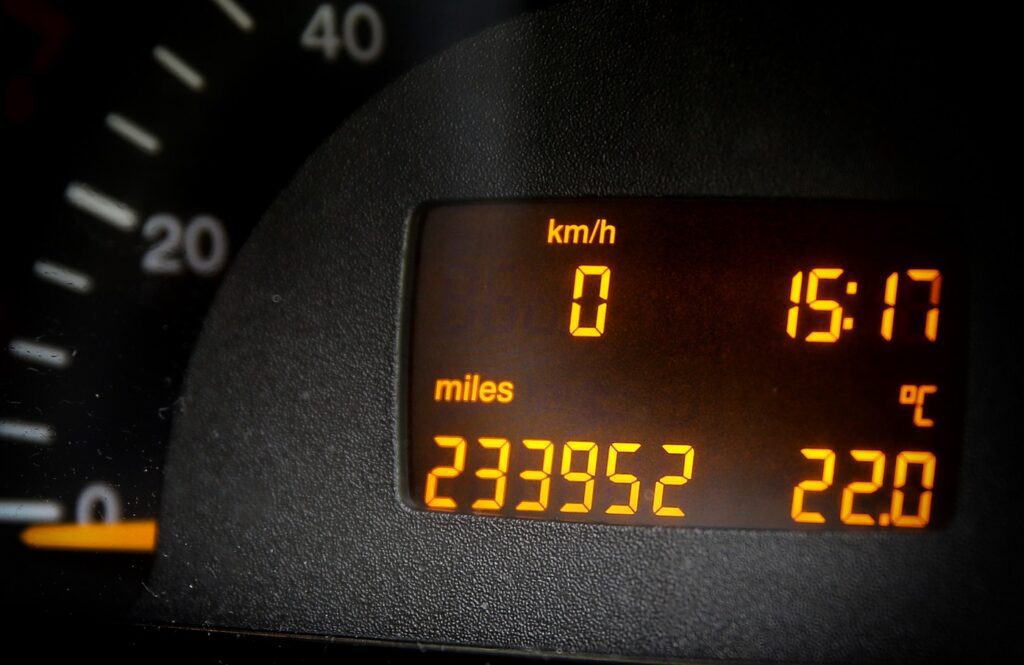
And warns motorists of the wear and tear dangers of buying a ‘clocked’ car www.hpicheck.com Long standing campaigner against so-called ‘mileage correction firms’, HPI, is applauding today’s news that Business Minister, Anna Soubry, has pledged a law change to close the loophole that enables fraudsters to wind back the miles on a vehicle’s odemeter. As many as 1.7 million* used cars with a fraudulent mileage reading could be on the UK’s roads, posing a considerable danger to other road users. Mileage correction firms are widespread throughout the UK, despite there being very few legitimate reasons for a vehicle to have its mileage altered – also known as “clocking”. Clocking is used by criminals to boost the sale price of a vehicle, often adding thousands of pounds to the asking price**. However, vehicle history check expert, HPI, warns that due to the computerised systems on modern vehicles today, clocking a car can have serious ramifications over and above a false mileage reading.
Buying your first car?
If you’re thinking about buying your first car, you’re completely overwhelmed at all the choices you can make. You might be torn between new or used, petrol or diesel, manual or auto, what bodystyle to go for – along with exactly which make and model to go for. Your budget will probably dictate what you buy, as a new car may be out of reach financially. However, if you’ve got an income and it’s realistic to sign up to an ongoing deal, paying a monthly fee and running a new car (on some sort of finance scheme) is well worth considering. It will be in warranty, should be cheap to run and it will also have an efficient engine plus lots of tech to keep you safe. Buying basics Although there’s a huge array of makes and models to choose from, you can discount most of them as they’ll cost too much to buy or run. You don’t want to be bankrupted by insurance costs or fuel and servicing bills, so you’ll have to home in on a city car or supermini (a compact hatchback) with a small engine; a bigger car with more performance will have to come later.
Dealing with car documentation after a sale

The DVLA recently introduced an electronic system for car log book documentation when buying or selling a used car in the UK. The electronic changeover began with driving license paper counterparts, quickly followed by the elimination of road tax discs. Now the V5C log book has gone the same way. In particular, the electronic system pertains to selling a vehicle to trade or private car buyers. Simply put, you no longer need to post the V5 log book to the driver vehicle licencing agency after selling up. Visit the DVLA here to declare change of ownership Read on for the full details of the DVLA’s changes to the UK V5C document, and how they affect you when selling or buying a car.
Petrol or diesel?
It took a long time for diesel cars to become popular in the UK, sales increases coming about largely because of tax incentives for fleet drivers. Until recently the rise of diesel seemed unstoppable, then Volkswagen was caught being dishonest and suddenly petrol-engined cars are back in favour once more. If you’re confused as to which way to go, read on… The driving experience Diesel cars are now so refined that a clattery engine is no longer a valid reason for avoiding one. What makes them so appealing is the extra muscle they provide; a diesel engine is inherently more torquey than a petrol one and it’s torque that gives you that effortless acceleration. As a result diesel cars are ideal for towing and they’re also perfect motorway cruisers because the engines don’t have to work as hard at high speeds. Indeed, it’s hard to think of a reason to avoid buying a diesel from a driving point of view, apart from the fact that they don’t rev like a petrol engine does – or sound as great at the redline. However, diesels do take longer to warm up, so if you do mainly short journeys you might find that in the winter the engine never gets warm and as a result the heater never works. That might seem annoying but it’s worse than that because most fuel consumption and engine wear takes place when an engine is cold.
March registrations – bag a bargain
Brits love their cars and they love to show them off – especially if it’s a new one with the latest registration plate. It’s a tradition that stretches back to 1963, when the original ‘suffix’ plates were introduced. Ever since then we’ve had a ‘year identifier’ that marks out when a car was first registered. Until 2001 we got one identifier per year, but when the current registration system was introduced we got two for each year; one for March and the other for September. As a result the previous single spike in new car sales became two, the March one being the bigger (and more popular) of the pair. With that in mind, we’ve just had the biggest spike in new car sales that we’ll see this year, so from here on until early 2017, dealers are going to have to work harder for your money. Which is why now is a great time to go shopping for that new car. Manufacturers have to keep churning out cars even if the demand isn’t really there for them; it’s no good running a factory at a fraction of capacity. To move those cars on, dealers are given targets and quotas, with plenty of incentives to keep shifting metal. Some marques have to work harder than others to shift stock, but even the premium brands have to try harder than you might think. When shopping for your new car, your mission is to secure the best discount you can, which means haggling hard and not being taken in by the salesman’s sob stories about how tight his margins are. But be realistic, as dealers generally make most of their profits from selling used cars and doing servicing. With most cheaper cars the margins are unbelievably small, which is why the bigger the car, the bigger the discounts available.
Insurance jargon explained
Drive a car and you have to have insurance to be legal, but understanding some of the terminology isn’t always easy. Before you buy an insurance policy it’s essential that you get to grips with what’s on offer; here’s how to decipher the code. Types of cover Legally, you need only Third Party insurance which covers claims by someone if you cause an accident that damages them or their property. The next level up is Third Party, Fire and Theft (TPFT) which adds protection against fire and theft to your Third Party cover. Fully comprehensive insurance covers you for everything, even if the accident is your fault. It’s not always the most expensive, but even if it is, it’s worth the extra because of the added protection. For more on the different types of car insurance check out our recent blog. No-claims discount For each 12 months that you insure a car without making a claim, you’ll earn a year’s no-claims bonus (NCB) or no-claims discount (NCD), usually up to a maximum of five years. How much this is worth depends on the insurer, but it’s not unusual for a five-year NCD to cut your premium by 60% or more. Normally, you need to have a policy in your own name to start earning your NCD. But if you’re a named driver on someone else’s policy, some insurers allow you to build up NCD of your own, if you then take out your own insurance with the same company.
Don’t get caught out by outstanding finance warns HPI

As Trading Standards take tougher action on dealers who fall foul www.hpicheck.com HPI is urging used car dealers to make vehicle history checks standard on all stock, regardless of the vehicle’s age, after a Trading Standards investigation led to a trader from Wales being successfully prosecuted for unwittingly selling on a car with outstanding finance against it. With as many as 1 in 4 cars hitting the HPI outstanding finance register, the risk to dealers of damaging their reputation and facing judicial punishment is painfully high. Although the dealer is known to regularly conduct HPI Checks, he admitted that he didn’t on all stock, particularly older vehicles, as was the case of the 55-reg Citroen C3 he sold on. This mistake cost him and his two colleagues involved a total of £1,700 in fines, legal costs and victim surcharges, under the Consumer Protection from Unfair Trading Regulations 2008. Neil Hodson, Deputy Managing Director for cap hpi, explains, “We’re often hearing about dealers being found guilty in a court of law for selling on clocked cars, be that intentionally or otherwise, but this case concerns outstanding finance which is actually rather rare. Dealers should treat this recent prosecution as a stark warning, given a quarter of cars checked with us are on outstanding finance.”
Supercars can make a super investment

The latest figures from cap reveal that the supercar market could offer a sound return on investment if buyers choose the right make and model. Overall, supercar and some sports car used values have remained level in a depreciating marketplace, but some vehicles are enjoying strong appreciation. Philip Nothard, cap consumer and retail editor, explains, “A savvy buyer would have earnt £18,500 buying a Mercedes Benz SLS in 2014 and selling it a year later with 10,000 miles on the clock. “For buyers looking for a comparable investment today, they should consider the 65 plate Ferrari 488 GTB Coupe, which cost £182,809 from new but in just six months amassing 5,000 miles it would retail at £215,500 – this is an increase of 17.8% or the Mercedes-Benz AMG GT Coupe, which has increased by almost £5,000 in six months from £100,055 to £104,750. “The supercar market is very niche, with a limited number of models available to choose. However, with some proper research, buyers can benefit from the buoyant market. It’s all about finding the right car, and those that are most sought after, bring the greatest returns. Another excellent example is a six month old Porsche Cayman Coupe 3.8 GT4 with a mileage of 5,000, which has appreciated by 38.4% from £64,451 to £89,250 proving that investing in these cars can be a lucrative option.” Philip Nothard concludes, “The key elements of a good supercar buy are model, mileage and plates. For this reason, beware of clocked vehicles, as a lower mileage will get a better price, so dodgy sellers may be tempted to drop the mileage and duping buyers into paying over the odds.” Image credit: Magiccarpics.co.uk