

Electric Car Facts & Stats
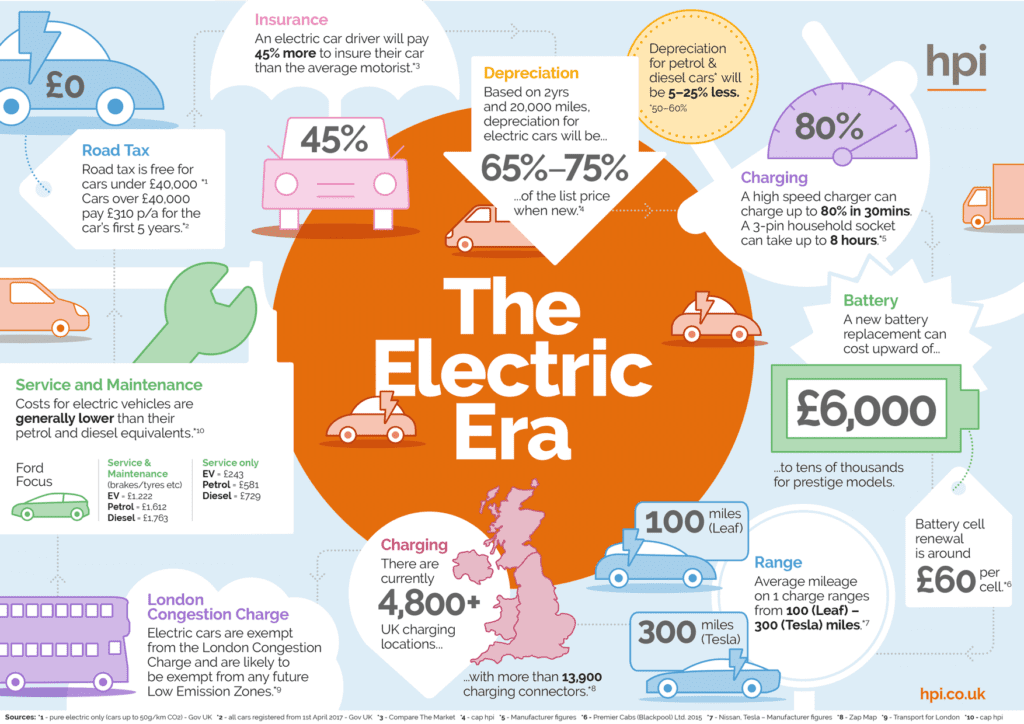
Electric cars are quite a hot topic right now, particularly since the government announced its ban on the sale of new diesel and petrol only cars by 2040. For those who want to do their bit to improve air quality, switching to an electric car is a perfectly feasible option once you know your your electric car facts. In our infographic below we’ve pulled together some interesting facts about electric cars that you should consider when deciding if switching to electric is right for you. We look at electric car range, electric car charging to depreciation and electric car road tax. Thinking of buying or selling a car? Visit hpi.co.uk for the best information available on any car
Electric Car Service & Maintenance Costs
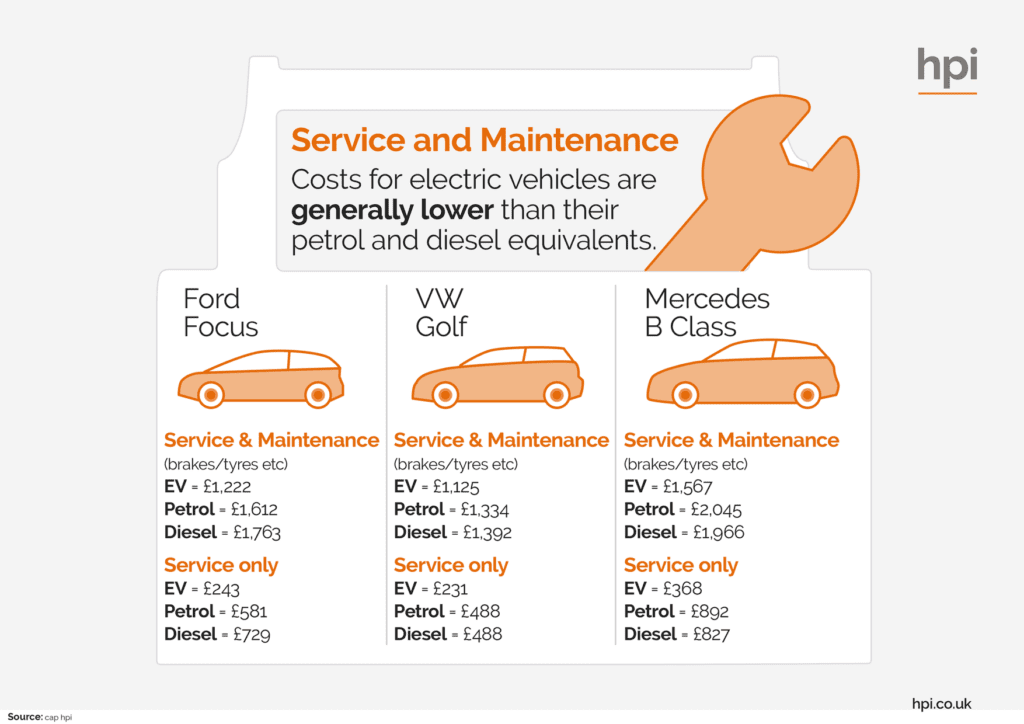
Are you wondering about the cost of an electric car service compared to diesel and petrol? Electric car service and maintenance costs are generally lower than for petrol and diesel. Below is a comparison for three models where there is a diesel and petrol version in the range. All are automatic models to keep the comparison as similar as possible as there are no manual electric vehicles. Note: Tyre sizes are the same with the exception of the Mercedes where the rim size is the same but with a different aspect ratio. Find out electric car service and maintenance costs with our free tool below. Service and maintenance costs are included as part of our free, easy to use valuation service. Our free valuation tool will tell you: Current market values for private sale, trade-in, forecourt and price at new Past, current and future trade-in values Total cost of motoring, incl. running costs, and costs for service and maintenance Our valuation tool isn’t just for electric cars, you can check service and maintenance costs for petrol and diesel cars too. Get a free valuation now! [iframe src=”https://hpivaluations.com/i/hpiblog/start” width=”360px” height=”370px” class=’aligncenter’ style=”margin:10px auto; height:370px”]
Electric Car Pros & Cons
Electric cars are in the news a lot at the moment, largely because air quality has become such a hot topic. Conventionally powered vehicles (petrol and diesel) are one of the key sources of pollution in busy city centres, and one of the main advantages of electric cars is that you’ll be doing your bit to reduce air pollution. Electric vehicles have been around since the dawn of motoring at the turn of the 20th century but it’s only within the past decade that they have become a mass-market proposition. The first mainstream model designed from the outset as an electric car was the Nissan Leaf (launched in 2010), and since then the market has expanded with models from BMW, Tesla and Renault among others. There are many things to consider when deliberating on the benefits of electric cars and whether or not an electric car is right for you. We’ve listed some pros and cons that are worth mulling over before you decide to make the switch. Advantages of electric cars: Improve local air quality More efficient, so fuel costs are lower Very easy to drive, nippy around town Cheaper to service (BEVs) Grants reduce purchase costs (BEV and PHEV) Can refuel quickly (HEVs and PHEVs) Disadvantages of electric cars: More costly to buy Lose value more quickly Patchy public charging network (BEVs and PHEVs) Often cost more to insure The range is often limited (BEVs) Sometimes no more frugal than a normal car (HEVs and PHEVs) Can take a long time to charge (BEVs) While it’s only recently that affordable and usable electric cars have been available in significant numbers, for years before that there was also an array of hybrid cars to choose from. While a hybrid car isn’t electric, it is electrified, and that’s an important distinction that many people are unaware of. Not only is there a difference, but to complicate things further, there are five types of electrified vehicle: Battery Electric Vehicle (BEV) These are electric cars that are powered solely by electricity stored in battery packs. Buy one and you’ll have to charge it up at home, at work or from a charging point such as on the motorway. There’s no on-board back-up power supply (i.e. an engine), so get caught with a flat battery and you’ll have to be recovered. BEVs include the Nissan Leaf, Renault Zoe and all Teslas, while BMW offers an electric-only i3. Hybrid Electric Vehicle (HEV) A hybrid is an electrified car that features either a petrol or diesel engine, although it’s rarely the latter, as diesel engines cost more to make than petrols. This engine drives the wheels and is backed up by an electric motor powered by a battery pack. The batteries are charged up by the engine, or when the car is slowed (either by using engine braking or the car’s foot brake). Examples include the Toyota Prius and lots of other Toyota and Lexus models, along with the Bentley Bentayga and Kia Niro. Plug-in Hybrid Electric Vehicle (PHEV) HEVs have an electric-only range of typically just four miles because of the size of the battery pack. By fitting a larger set of batteries the electric-only range can be increased to more like 30 miles, with efficiency being improved by having the ability to recharge the car via a mains supply. Such cars are called plug-in hybrids (PHEVs) and they bridge the gap between a pure electric car (BEV) and a conventional hybrid in that it contains the best elements of both. As a result these cars are costly but they have still become much more common over the past couple of years, with the introduction of models by BMW, Mercedes, Volvo, Volkswagen and many more. Range extender (REX) The range extender is much like a plug-in hybrid to use, as it features a petrol engine and a battery pack. However, the wheels are always driven by electric motors powered by the battery pack which is charged up by the engine. So the engine acts solely as a generator, but there’s always the option of charging up the battery pack from a mains supply. The now-defunct Vauxhall Ampera and Chevrolet Volt were the first range extenders to be sold in the UK; the BMW i3 and i8 are still on sale though. Hydrogen fuel cell Just to complicate things there’s a fifth type of electrified car, and that’s the hydrogen fuel cell. Available in tiny numbers, the only model available in the UK is the Toyota Mirai, although Hyundai sold a hydrogen ix35 until recently. Although car makers have been developing hydrogen fuel cell models for decades, the technology is still in its infancy. So is the infrastructure as there are just four hydrogen refuelling stations in the whole of the UK, three of which are in London. The difficulty with making a viable hydrogen fuel cell car is reducing the cost, improving the reliability and shrinking the technology to a suitable size. While mass-market hydrogen fuel cell cars are still some way off, the technology is being used in buses, which in diesel form are one of the key sources of pollution in urban environments. By switching to hydrogen this pollution is eliminated altogether, as the only emission from a hydrogen fuel cell is water. Although there are five different electrification technologies, they all get lumped together as AFVs, or Alternatively Fuelled Vehicles. So an AFV is simply a vehicle that’s electrified, which can mean that it’s pure electric, a hybrid or a range extender, with the odd hydrogen fuel cell thrown in for good measure. Such vehicles are starting to prove big business as they accounted for 4.6% of the cars sold in the UK up to the end of September, which equates to over 94,000 units. But is an AFV right for you? Richard Dredge Thinking of buying or selling a car? Visit hpi.co.uk for the best information available on any car
The Future Of Diesel – Video Explainer
Poor air quality has become a huge topic of discussion lately and diesel is said to be one of the main sources of air pollution. Diesel engine vehicles have been targeted by governments around the globe as part of their action plan to clean things up. The UK government recently announced a ban on the sale of new diesel and petrol only vehicles by 2040. Aside from a diesel car ban there are other measures in effect or pending that could affect diesel drivers in the UK. We answer some important questions: Will this affect diesel car values? Should you still buy a diesel? What is the diesel scrappage scheme? Diesel vs petrol? Our short video paints the bigger picture and provides some interesting facts to help you understand what the future of diesel cars looks like. Use our free valuation tool to find out the current and future value of your diesel [iframe src=”https://hpivaluations.com/i/hpiblog/start” width=”360px” height=”370px” class=’aligncenter’ style=”margin:10px auto; height:370px”]
The Future of Diesel – Diesel Facts & Stats
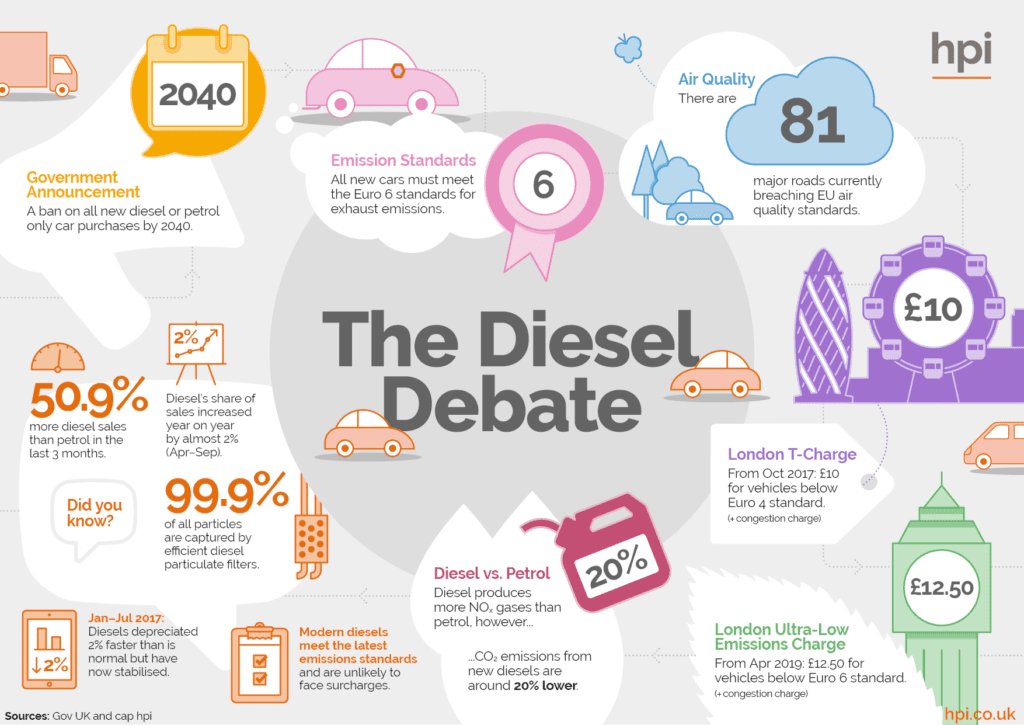
The future of diesel cars is a hot topic right now and there is a lot of worrying information flying around that doesn’t paint the brightest picture for diesels. With that said, we decided to pull together some interesting diesel facts and statistics that may well surprise you. Have diesel values been affected? Diesel vs petrol – how does diesel fare against petrol when it comes to air pollution? Are people still buying diesel cars? What kind of surcharges are being imposed on cars that don’t meet Euro Emissions Standards. Use our free valuation tool to find out the current and future value of your diesel [iframe src=”https://hpivaluations.com/i/hpiblog/start” width=”360px” height=”370px” class=’aligncenter’ style=”margin:10px auto; height:370px”]